Gold vs Silver for Investment in 2026: Which Precious Metal Is Right for Your Portfolio?
 Krishna
 Published:
 Updated:
 Read time:6 Minutes
Table of contents
When it comes to gold vs silver for investment in 2026, the debate has never been more relevant. Both precious metals delivered extraordinary returns in 2025, with gold rising approximately 65% and silver posting even sharper gains driven by industrial demand. Yet after a significant correction in early 2026, many investors are re-evaluating their strategy. Should you lean toward gold’s stability or silver’s higher growth potential?
The answer depends on your goals, risk tolerance, and time horizon. This comprehensive guide breaks down the key differences, recent performance data, and practical considerations to help you make an informed decision.
Why Precious Metals Matter in 2026
Global economic uncertainty, persistent inflation concerns, and shifting interest rate expectations have kept precious metals in the spotlight. Central banks continue to accumulate gold, while silver benefits from explosive demand in solar panels, electric vehicles, and electronics.
Both assets serve as portfolio diversifiers, but they behave differently. Understanding these distinctions is essential before committing capital.
Gold vs Silver at a Glance: Quick Comparison
Here’s a side-by-side view of the most important factors:
| Feature | Gold | Silver |
|---|---|---|
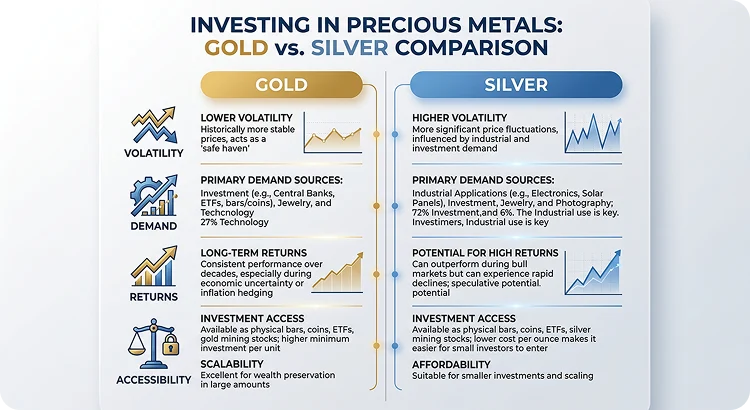
| Volatility | Lower and more stable | Significantly higher (2-3x gold) |
| Primary Demand | Investment, jewelry, central banks | Industrial (50%+), jewelry, investment |
| Long-term Returns | Stronger historical compound growth | Higher short-term upside potential |
| Accessibility | Higher entry cost | Much more affordable per ounce |
| Safe Haven Status | Excellent during crises | Moderate, more tied to economic cycles |
Historical Performance: What the Numbers Reveal
Long-term data strongly favors gold as a wealth preservation asset. According to historical analysis spanning nearly a century:
- From 1925 to 2023, gold delivered an average annual compound return of approximately 4.81%.
- Silver returned about 3.71% over the same period.
A $1,000 investment in gold in early 1976 would have grown to roughly $37,944 by March 2026. The same amount in silver would have reached approximately $20,126. Gold has consistently protected purchasing power better across multiple economic cycles.
However, the picture changes when we look at more recent periods. Over the past 10 years (2016–2026), silver has often outperformed gold during industrial expansion phases. In 2025 specifically, silver’s percentage gains significantly exceeded gold’s, thanks to surging demand from green energy and technology sectors.
This highlights an important truth: gold excels at preserving wealth over decades, while silver offers greater upside during periods of strong industrial growth, but with much larger price swings.
Gold’s lower volatility and stronger track record as a monetary asset make it the preferred choice for conservative, long-term investors. Silver’s dual role as both a monetary metal and critical industrial commodity creates more dramatic price movements, both upward and downward.
Volatility and Risk: Which Metal Swings More?
One of the most important distinctions in the gold vs silver for investment debate is volatility. Silver prices typically move two to three times more dramatically than gold on any given day. This characteristic creates both opportunity and risk.
In 2025, silver’s explosive rally delivered outsized gains for those who held it. However, the sharp correction in early 2026 showed the other side of the coin, silver gave back a significant portion of its gains much faster than gold. Investors with lower risk tolerance often find gold’s steadier price action more comfortable, especially during periods of economic stress or rising interest rates.
Key points to consider:
- Gold tends to act as a reliable safe haven when stock markets fall or geopolitical tensions rise.
- Silver’s higher beta means it can outperform during economic expansions and industrial booms, but it can also decline sharply when risk appetite fades.
- For short-term traders or those seeking higher returns, silver’s volatility can be attractive. For long-term wealth preservation, gold’s lower volatility is generally preferred.
If your portfolio already contains growth assets, adding gold can provide better ballast. Those comfortable with larger price swings and a longer holding period may allocate more toward silver.
Demand Drivers: Monetary Power of Gold vs Industrial Might of Silver
Understanding what drives each metal’s price is crucial for the gold vs silver investment decision.
Gold’s demand is overwhelmingly monetary and investment-related. Central banks, ETFs, and individual investors buy it primarily as a store of value and inflation hedge. Its industrial uses are limited, which makes its price less sensitive to economic cycles.
Silver, by contrast, has a dual personality. More than 50% of annual silver demand now comes from industrial applications, including:
- Solar panel manufacturing
- Electric vehicles and charging infrastructure
- Electronics and semiconductors
- Medical devices and 5G technology
This industrial exposure means silver prices often rise strongly during periods of global economic growth and green energy expansion. At the same time, it makes silver more vulnerable when manufacturing slows or recession fears grow.
In recent years, structural supply deficits in silver have added upward pressure. While gold benefits from consistent central bank buying, silver’s price can receive an extra boost, or face extra pressure, from real-world industrial consumption trends.
The Gold-to-Silver Ratio Explained
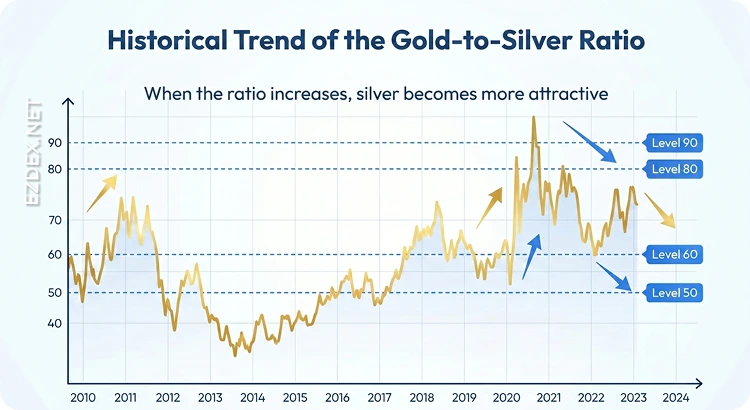
The gold-to-silver ratio shows how many ounces of silver it takes to buy one ounce of gold. As of mid-2026, the ratio stands around 62:1.
Historically, this ratio has fluctuated widely:
- Long-term average often sits between 40:1 and 60:1
- Extreme readings above 80:1 or 100:1 have sometimes signaled that silver was undervalued relative to gold
- Very low readings (below 40:1) have occasionally indicated silver was expensive compared to gold
Many experienced precious metals investors watch this ratio closely. When it is relatively high, some shift a portion of their allocation toward silver expecting mean reversion. When the ratio compresses significantly, they may favor gold or rebalance.
It is important to remember that the ratio is a relative valuation tool, not a precise timing indicator. It works best when combined with fundamental analysis of industrial demand, mining supply, and macroeconomic conditions.
Accessibility, Costs and Liquidity
Another practical difference in gold vs silver for investment is how easy and expensive it is to buy and sell each metal.
Silver’s much lower price per ounce makes it far more accessible for smaller investors. You can purchase meaningful quantities with modest capital and dollar-cost average more easily. However, storage and insurance costs for physical silver can be proportionally higher because of its bulk.
Gold, while more expensive per ounce, is denser and easier to store in smaller quantities. It also tends to have tighter bid-ask spreads in many markets and is generally more liquid when selling larger amounts.
Both metals can be purchased in several convenient forms:
- Physical bullion (coins and bars)
- Exchange-traded funds (ETFs)
- Mining company stocks and funds
- Allocated storage accounts
Each method has different costs, convenience levels, and tax implications that should be evaluated based on your individual situation.
How to Invest in Gold and Silver
There are several practical ways to gain exposure to gold and silver, each with different levels of convenience, cost, and risk.
Physical bullion (coins and bars): This is the most direct form of ownership. You take delivery of the metal and can store it yourself or in a professional vault. Physical ownership offers the highest level of privacy and control but involves premiums above spot price, storage costs, insurance, and potential liquidity challenges when selling.
Also Read: Gold Bullion vs Jewerly
Exchange-Traded Funds (ETFs): Gold and silver ETFs are popular among investors who want exposure without the hassle of storing physical metal. These funds track the price of the underlying metal and trade like stocks on major exchanges. They offer excellent liquidity, low costs, and ease of buying and selling through regular brokerage accounts.
Mining stocks and funds: Investing in gold and silver mining companies provides leveraged exposure to metal prices. When gold or silver prices rise, mining stocks often move more dramatically. However, they also carry additional risks such as operational issues, management decisions, and geopolitical factors affecting mines.
Many investors use a combination of these methods. For example, holding some physical metal for long-term security while using ETFs for easier trading and portfolio rebalancing.
Gold vs Silver in 2026: Which Should You Choose?
The right choice depends on your personal financial goals and risk profile.
Choose gold if you prioritize:
- Capital preservation over many years
- Lower price volatility
- Strong performance during financial crises or high inflation
- A more established monetary asset with consistent central bank demand
Choose silver if you seek:
- Higher growth potential during periods of industrial expansion
- Greater affordability and easier dollar-cost averaging
- Exposure to the green energy and technology megatrends
- The possibility of larger percentage gains (with correspondingly larger drawdowns)
Many experienced investors do not choose exclusively between the two. Instead, they hold both metals in a diversified precious metals allocation. Gold provides stability while silver offers additional upside tied to real economic activity.
Smart Portfolio Allocation Strategies
How much should you allocate to precious metals, and how should you split it between gold and silver?
While there is no universal answer, many financial advisors suggest limiting precious metals to 5–15% of a well-diversified investment portfolio. Within that allocation, a common starting point is a heavier weighting toward gold for its stability, with a smaller but meaningful portion in silver for growth potential.
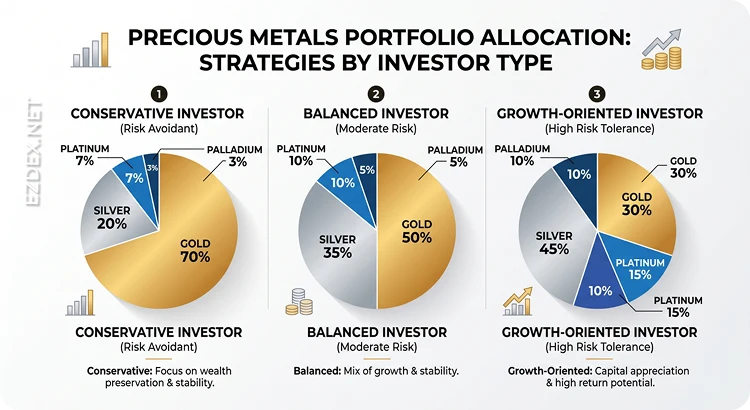
Here is one example allocation framework:
| Investor Profile | Total Precious Metals | Gold Portion | Silver Portion | Rationale |
|---|---|---|---|---|
| Conservative | 5–8% | 70–80% | 20–30% | Focus on stability and wealth preservation |
| Balanced | 8–12% | 60–70% | 30–40% | Blend of preservation and growth |
| Growth-oriented | 10–15% | 50–60% | 40–50% | Higher silver weighting for industrial upside |
These percentages should be adjusted based on your age, overall portfolio composition, and outlook for inflation and industrial demand. Regular rebalancing helps maintain your desired risk level as metal prices fluctuate.
It is also wise to consider your investment timeline. Investors with a very long horizon (10+ years) can comfortably hold a higher silver allocation, while those closer to needing liquidity may prefer more gold.
Risks, Taxes and Storage Considerations
While gold and silver can strengthen a portfolio, they are not without risks. Understanding these factors is essential before investing.
Price volatility remains the most obvious risk, particularly with silver. Sharp corrections can test even experienced investors’ resolve. Gold is generally more stable but can still experience significant drawdowns during periods of rising real interest rates or a stronger U.S. dollar.
Physical ownership brings additional considerations. You must securely store and insure your metals. Theft, damage, and high storage costs are real concerns for larger holdings. Many investors use professional allocated storage or bank safe deposit boxes to mitigate these issues.
Paper products such as ETFs and futures carry counterparty and tracking risk. While generally reliable, they do not give you direct ownership of physical metal. In extreme systemic stress, some investors prefer having metal they can physically hold.
Taxes vary significantly by country and investment vehicle. In many jurisdictions, physical gold and silver are taxed as collectibles at higher long-term capital gains rates than stocks. ETFs may receive more favorable tax treatment. Always consult a tax professional familiar with precious metals in your location.
Liquidity is generally good for major gold and silver products, but during market panics, spreads can widen and selling large quantities of physical metal quickly may be challenging.
Diversification across multiple forms (physical + ETF) and careful position sizing help manage these risks effectively.
Final Thoughts: Building a Resilient Portfolio with Gold and Silver
The gold vs silver for investment question does not have a single correct answer for everyone. Gold has proven itself over centuries as a reliable store of value and portfolio diversifier. Silver offers higher growth potential tied to industrial progress but comes with greater volatility.
In 2026, both metals continue to play valuable roles. Many successful investors hold a core position in gold for stability while adding a satellite allocation to silver to capture industrial upside. This balanced approach allows you to benefit from the unique strengths of each metal while reducing the impact of any single asset’s weaknesses.
The most important step is to start with a clear plan. Determine how much of your portfolio you want to allocate to precious metals, decide on the right mix of gold and silver for your goals, and choose investment vehicles that match your preferences for convenience and ownership.
Whether you are protecting wealth against inflation and uncertainty or seeking growth from the green energy transition, precious metals can be a powerful addition to a well-constructed portfolio.
Ready to take action? Begin with a modest allocation you can comfortably hold for the long term, use dollar-cost averaging to reduce timing risk, and review your positions periodically. Consider speaking with a financial advisor who understands commodity investments to tailor a strategy to your specific situation.
FAQ
Is silver a better investment than gold in 2026?
It depends on your goals. Silver offers higher growth potential due to industrial demand but comes with significantly more volatility. Gold provides greater stability and has a stronger long-term track record as a wealth preserver.
What is the current gold-to-silver ratio and why does it matter?
As of mid-2026, the ratio is approximately 62 ounces of silver to one ounce of gold. A higher ratio can sometimes indicate silver is undervalued relative to gold, while a lower ratio may suggest the opposite. It is one of several tools investors use to compare the two metals.
How much of my portfolio should be in gold or silver?
Many advisors recommend keeping precious metals between 5% and 15% of a diversified portfolio. Within that allocation, a heavier weighting toward gold is common for stability, with a smaller portion in silver for growth potential.
Can I lose money investing in gold and silver?
Yes. Both metals can experience significant price declines. They do not generate income like dividends or interest, and their prices are influenced by macroeconomic factors, interest rates, and investor sentiment.
What is the best way for beginners to invest in gold and silver?
Many beginners start with reputable gold and silver ETFs for simplicity and liquidity. Those who prefer physical ownership can buy coins or bars from established dealers and use professional storage services.
Do gold and silver protect against inflation?
Both have historically served as inflation hedges over long periods, though their effectiveness can vary depending on the economic environment. Gold has generally been more consistent in this role.
Should I buy physical gold and silver or use ETFs?
It depends on your priorities. Physical metal gives direct ownership and privacy but involves storage and insurance costs. ETFs offer convenience, lower costs, and easy trading but do not provide physical possession.
Latest in Silver Guides
All articles in this category