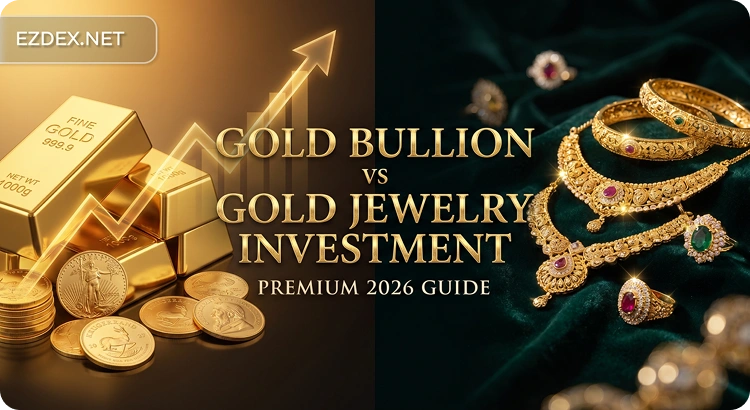
Gold Bullion vs Gold Jewelry Investment: Which Is Better in 2026?
 Krishna
 Published:
 Updated:
 Read time:8 Minutes
Table of contents
In 2026, with ongoing economic uncertainty, inflation concerns, and geopolitical tensions, more investors than ever are turning to physical gold. But a common dilemma remains: should you invest in gold bullion (bars and coins) or gold jewelry?
This comprehensive guide breaks down the key differences, pros, cons, real numbers, and expert strategies to help you make the right decision for your portfolio and lifestyle.
What Is Gold Bullion and How Does It Work as an Investment?
Gold bullion refers to physical gold in its purest form, typically 99.99% pure (999 fine), shaped into bars, coins, or rounds. It is bought and sold primarily for its intrinsic metal value, closely tracking the global spot price of gold.
Popular forms include:
- Gold bars (1g to 1kg or larger)
- Gold coins (American Eagle, Canadian Maple Leaf, Krugerrand, etc.)
- Fractional bullion for smaller investors
Why investors love bullion:
- Highest purity and liquidity
- Minimal premiums over spot price (usually 1–5%)
- Easy to verify authenticity (serial numbers, assay certificates)
- Recognized globally by refiners and dealers
In 2026, the average premium for a 1 oz gold bar sits around 2.5–3.8% above spot, making it one of the most cost-efficient ways to own physical gold.
Gold Jewelry as an Investment: Benefits and Hidden Costs
Gold jewelry combines the beauty of craftsmanship with the value of gold. It comes in various purities, commonly 18K (75% gold), 22K (91.6% gold), and occasionally 24K in certain markets.
While jewelry can appreciate with the price of gold, it carries additional costs and considerations that bullion does not.
Common types of investment-grade jewelry:
- 22K or 24K plain gold bangles, chains, and coins embedded in jewelry
- Designer pieces from reputable brands
- Traditional cultural jewelry (especially popular in India, Middle East, and Southeast Asia)
However, jewelry is rarely bought solely for investment. Most people purchase it for wearing, gifting, or cultural significance, which adds both emotional and practical value.
Key Differences: Bullion vs Jewelry at a Glance
Here’s a quick comparison table (updated for 2026 market conditions):
| Factor | Gold Bullion | Gold Jewelry |
|---|---|---|
| Purity | 99.99% (999 fine) | 75% (18K) to 99% (24K) |
| Premium over Spot | 1–5% | 15–100%+ (including making charges) |
| Liquidity | Very High (sell anywhere globally) | Medium to Low (depends on design) |
| Resale Value | 95–99% of spot price | 60–85% of melt value (after charges) |
| Storage & Insurance | Simple, standardized | Requires careful handling |
| Emotional/Cultural Value | None | High (wearable wealth, status) |
| Best For | Pure investment & wealth preservation | Lifestyle + partial investment |
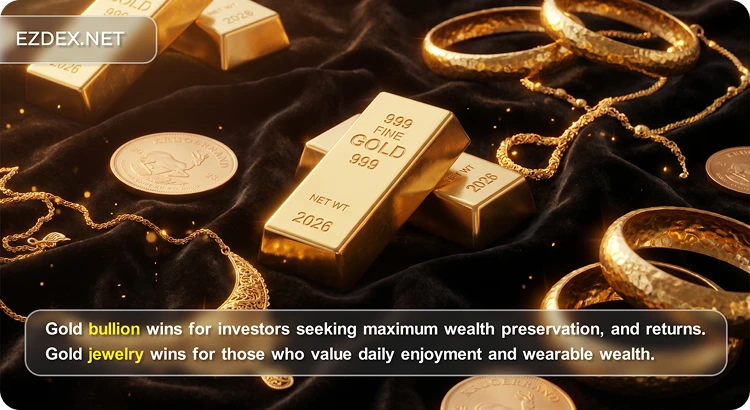
Key takeaway from the table: Bullion wins on pure financial metrics, while jewelry shines when you want to enjoy the asset daily.
Pros and Cons of Investing in Gold Bullion
Pros:
✅️Maximum gold content per dollar spent
✅️Easy to sell quickly at competitive prices
✅️Transparent pricing tied directly to spot gold
✅️Ideal for portfolio diversification and inflation hedging
✅️Lower storage and insurance costs for equivalent gold weight
Cons:
❌️No aesthetic or wearable appeal
❌️Can feel cold or purely transactional
❌️Subject to theft risk if not stored properly (vault recommended for large holdings)
Pros and Cons of Investing in Gold Jewelry
Pros:
✅️Wearable wealth, enjoy it while it potentially appreciates
✅️Cultural and sentimental value (especially in Asian and Middle Eastern markets)
✅️Potential for unique designs that may gain collector value
✅️Easier to gift or pass down through generations
Cons:
❌️High making charges (10–50% or more) that are lost upon resale
❌️Lower purity means less actual gold per gram
❌️Resale value heavily depends on current fashion trends and buyer preference
❌️Harder to verify purity without professional testing
❌️Risk of damage or wear reducing value over time
Bullion or Jewelry: Which Is Better for Long-Term Investment in 2026?
The answer depends on your goals, time horizon, and personal circumstances. Here’s a clear 2026 perspective:
Gold bullion is generally the superior choice for pure long-term investment. Why? Because in 2026, with gold spot prices hovering near all-time highs and expected to rise further due to central bank buying and persistent inflation, every percentage point of premium and purity matters.
Realistic return scenarios (based on current market data):
- Bullion scenario: You buy 10 oz of gold bullion at a 3% premium. After 5 years, if gold rises 40%, you can sell at 98–99% of spot, so net return close to the full gold price appreciation.
- Jewelry scenario: You buy 10 oz equivalent in 22K jewelry with 25% making charges. Even if gold rises 40%, resale typically recovers only 70–80% of the melt value after charges and depreciation, so your effective return drops significantly.
When jewelry can still make financial sense in 2026:
- You live in markets where 22K–24K plain jewelry has strong resale demand (India, UAE, Saudi Arabia, Turkey).
- You plan to wear it occasionally and treat the “enjoyment factor” as part of the return.
- You want a culturally acceptable form of wealth storage that family members appreciate.
Expert rule of thumb for 2026:
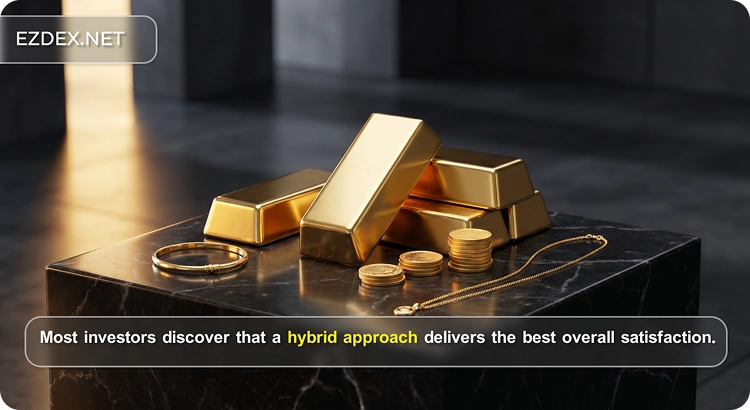
Allocate 70–90% of your physical gold portfolio to bullion for core wealth preservation.
Use 10–30% for high-quality 22K/24K jewelry if you value wearability and cultural significance.
How to Buy Gold Bullion or Jewelry Safely in 2026
For Gold Bullion Best Practices are:
- Buy from reputable dealers with LBMA accreditation (e.g., APMEX, JM Bullion, Kitco, or local trusted refiners).
- Always request assay certificates and serialized products.
- Compare premiums live, aim for under 4% on 1 oz+ bars or coins.
- Consider government-minted coins for easier recognition and slightly better liquidity in some regions.
- Use secure storage: home safe for small amounts, or professional vaults/banks for larger holdings.
For Gold Jewelry, Smart Buying Tips are:
- Stick to 22K or 24K plain designs (minimal stones or intricate work) to reduce making charges.
- Buy from established jewelers with buy-back guarantees.
- Ask for a detailed receipt showing gold weight, purity, and making charges separately.
- Get independent purity testing (XRF machine) before large purchases.
- Focus on timeless styles rather than trendy designs to protect resale value.
Red flags to avoid in 2026:
- Extremely low premiums on bullion (could indicate counterfeit or underweight products).
- Jewelry with very high making charges (>40%) or heavy diamond/gem embellishments.
- Sellers without transparent pricing or return policies.
Tax and Storage Considerations for Gold Investments
Tax Implications (varies by country, 2026 overview):
- Bullion: Often treated as a collectible or capital asset. Long-term capital gains tax rates usually apply after 1–3 years of holding.
- Jewelry: May be classified as personal use asset in some jurisdictions, potentially triggering different tax rules upon sale. VAT/GST is frequently added at purchase and not always fully recoverable.
Always consult a local tax advisor, countries like India, UAE, and the US have specific rules for precious metals.
Also Read: Tax Free Gold Investment Zones
Storage and Security:
- Bullion: Compact and easy to store. Professional depositories offer insurance and audit services.
- Jewelry: Requires more careful handling to prevent scratches, dents, or loss of stones. Home insurance riders are recommended.
FAQ
Is gold jewelry ever a better investment than bullion?
Only in specific cultural markets (India, UAE, Saudi Arabia) where 22K–24K plain jewelry has strong buy-back programs and low making charges. In most Western markets, bullion is almost always superior for pure returns.
How much should I invest in physical gold in 2026?
Financial experts recommend 5–15% of your total portfolio in physical gold. Split it 70–90% bullion and the rest in high-quality jewelry if you want wearable wealth.
What is the biggest hidden cost in gold jewelry?
Making charges (10–50%+) and lower purity. These are permanently lost on resale, unlike bullion which has minimal premiums.
Can I sell gold bullion or jewelry easily during a crisis?
Bullion is far more liquid, you can sell globally within hours at close to spot price. Jewelry resale can take longer and offers lower recovery.
Should I buy 24K jewelry or stick to bullion?
24K jewelry is rare and fragile for daily wear. Most investors choose bullion for purity and 22K jewelry only for cultural or lifestyle reasons.
Are there tax advantages to one over the other?
Bullion often qualifies for better long-term capital gains treatment in many countries. Jewelry may be taxed as personal property. Always check local regulations.
Latest in Gold Tutorials
All articles in this category