Symbol:
 Unit:
Unit: Central Bank:
 Bills:
Gold History & Its Role in the Economy
Gold is one of the oldest and most valuable metals in human history. The use of gold dates back thousands of years, and evidence shows that ancient civilizations such as the Egyptians, Sumerians, and South American civilizations used this precious metal to make jewelry, tools, and religious objects.
Over time, in addition to its decorative and religious aspects, gold became recognized as an economic tool and a standard of value. From around 600 BC, some governments and empires minted gold coins and used them as a medium of exchange and a store of value. This process gradually caused gold to play an important role in stabilizing currency values and the global economy.
In the Middle Ages and the modern era, gold served as the monetary backing of countries, and the gold standard laid the foundation for modern financial systems. In this system, the value of each country’s currency was tied to a specific amount of gold, which created trust in international trade and economic stability. Even after the official abandonment of the gold standard in the twentieth century, gold has remained important as a reserve asset for central banks and investors and is recognized as a safe investment during periods of economic crisis.
Overall, gold has not only been a valuable commodity and a symbol of wealth throughout history, but it has also played a vital role in economic development, creating financial stability, and shaping monetary policies. This precious metal continues to remain a reliable benchmark in the global economy and is used in the form of jewelry, investments, and reserves of banks and governments.
Differences Between Gold Karats & Global Standards
In fact, the karat of gold indicates the purity and the percentage of gold present in a piece of metal.
The higher the karat of gold, the greater the amount of pure gold and the fewer the impurities. In other words, the karat specifies the percentage of actual gold relative to the total weight of the piece.
Common Karats
Below, we have briefly reviewed common karats and the characteristics of each:
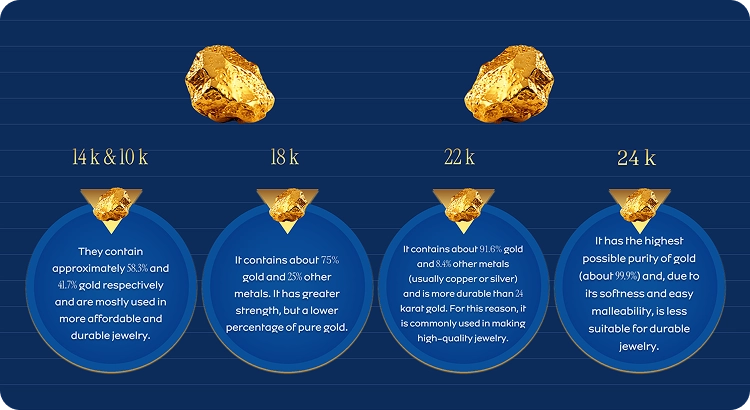
- 24 karat (pure gold): Has the highest possible purity of gold (about 99.9%) and, due to its softness and easy malleability, is less suitable for durable jewelry.
- 22 karat: Contains about 91.6% gold and 8.4% other metals (usually copper or silver) and is more durable than 24 karat gold. For this reason, it is commonly used in making high-quality jewelry.
- 18 karat: Contains about 75% gold and 25% other metals. It has greater strength, but a lower percentage of pure gold.
- 14 and 10 karat: Contain approximately 58.3% and 41.7% gold respectively and are mostly used in more affordable and durable jewelry.
Note: Pure gold is soft and fragile; therefore, it is alloyed with other metals for everyday use. A higher karat has greater value, but lower durability.
Global Standards
To prevent fraud and ensure quality, gold is internationally measured based on grams and specific karats. Global standards that determine the price of gold include the following:
- Karat or K: A traditional system that divides purity out of 24 (for example, 18K means 18 parts gold out of 24 parts).
- Fine Gold: The purity level of pure gold expressed as a percentage or parts per thousand; for example, 24 karat gold is equal to 999‰ (per thousand).
- ISO 8654: An international standard for determining the purity and specifications of investment gold and jewelry. (Learn more about ISO 8654)
In general, in international gold transactions, accurate declaration of gold karat and standards is very important to prevent differences in value and quality.
Factors Affecting Gold Price
A set of economic and political factors can affect the price of gold. Knowing these factors helps investors and market participants better understand gold price trends and take timely action to buy or sell.
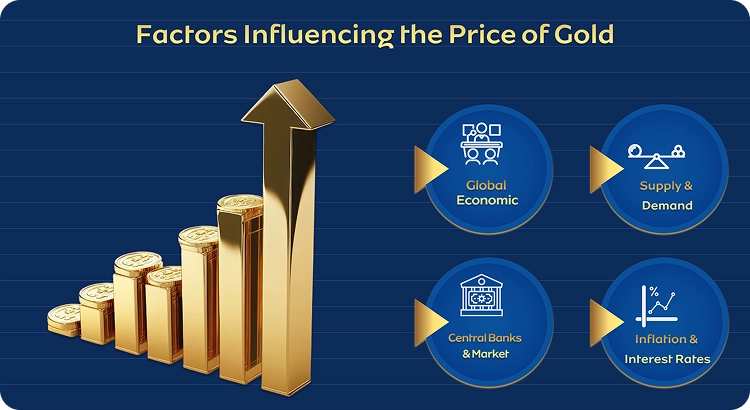
Supply & Demand
Supply refers to the amount of gold extracted from mines and the gold returned to the market, meaning gold sold by the public, which affects prices. A decrease in supply usually leads to higher prices. However, the factor with greater impact is demand. Consumer demand for jewelry, central banks’ demand for foreign exchange reserves, and investors’ demand for investment affect prices. An increase in demand raises the price of gold.
Inflation & Interest Rates
Gold acts as a safe investment and a kind of shelter against the decline in the value of money. Rising inflation increases demand for gold and leads to higher prices.
On the other hand, the effect of interest rates cannot be ignored. Higher interest rates make bank deposits and bonds more attractive and reduce demand for gold, because gold does not generate cash returns.
Global Economic & Political Conditions
Economic crises, wars, and political instability increase concerns and demand for safe investments and push gold prices higher. Whenever news of war intensifies in the world, investors know that gold prices are rising.
Central Banks & the Investment Market
The buying or selling of gold reserves by central banks, monetary policies, and changes in gold reserves can have a direct impact on global supply and prices.
Stock market fluctuations, gold futures trading, and the activity of exchange-traded funds (ETFs) also have a significant effect on short-term and long-term prices.
The Best Time to Buy and Sell Gold
As mentioned, the price of gold is influenced by many economic, political, and psychological factors, and its fluctuations can create good opportunities for buying or selling. Understanding these factors helps investors and those interested in gold make better decisions.
As is clear, the best time to buy gold is when global or domestic prices decline. That is, when global gold prices or domestic gold prices fall due to economic reasons, a decline in the value of the dollar, or reduced demand, it is a good time to buy. During periods when inflation is under control or there is an expectation of interest rate cuts, gold is relatively more attractive to buy compared to other investments.
Forecasting future price fluctuations by analysts and traders is done by analyzing past market data and considering these factors. Analyzing past market trends and future expectations can indicate the best month of the year to buy gold.
The best time to sell gold is when global or domestic prices rise, especially if you intend to sell or need liquidity from your investment. When gold prices rise due to an increase in the dollar rate, inflation, or economic crises, it is a good time to sell.
One point to consider when identifying the right time to buy and sell gold is that the gold market usually undergoes a short-term correction after a sharp price increase. Buying during a correction and selling before a correction can result in better profits.
Continuous and gradual buying of gold over time reduces the risk of short-term fluctuations.
How to Calculate the Price of Gold
Calculating the price of gold depends on various factors such as karat, weight, global gold price, exchange rate, and making charges.
In general, you need to multiply the weight of the gold by its price based on the specified karat to calculate the net price. However, if there are making charges and taxes, the formula changes slightly.
The formula for calculating the price of gold jewelry and ornaments is as follows:
Price = [Weight × (Base Price + Making Charge, if applicable)] + Profit Percentage + Tax Percentage
Gold coins are usually priced based on weight and 22 karat gold, and their making charges are lower. The formula for calculating their real price is as follows; if the market price is higher than this amount, it is commonly said that the coin price includes a premium.
Coin Price = Coin Weight × Karat Ratio × Global Gold Price × Dollar Exchange Rate + Coin Minting Fee
Keep in mind that the karat of gold directly affects the price. For example, 24 karat gold is more expensive than 18 karat gold.