What Is Gold Karat? A Guide to Identifying Methods & Comparison
 Krishna
 Published:
 Updated:
 Read time:8 Minutes
Table of contents
Gold karat is one of the most important concepts in the world of gold investment and the purchase of jewelry and ornaments. This factor essentially represents the purity and quality of the gold in a piece. Whether you are looking to invest in gold, make a personal purchase, or even sell your old gold items, understanding karat is essential. In this article, we take a comprehensive look at the concept and importance of it, examine different karat types and their impact on price and purity, and provide information about common karats in various countries around the world as well as methods for identifying karat. Read on to learn everything you need to know about gold karat.
What Is Gold Karat?
Gold is a soft and malleable metal, which is why it is not durable enough on its own for making jewelry or decorative items. Therefore, it is combined with other metals such as copper, silver, zinc, or nickel to increase its hardness and durability.
Gold karat indicates the level of purity and the percentage of pure gold in a piece. A lower karat usually means a lower price but greater durability, while a higher karat has more value but is softer.
In the global standard, each karat is equal to 4.17 percent gold. Therefore, when we say a piece of gold is 18 karats, it means that 18 × 4.17 percent (about 75 percent) of it consists of pure gold.
In the international standard system, karat is measured on a 24-unit scale. Twenty-four karat gold means pure gold (99.9 percent gold), while 18 karat gold contains 75 percent gold and 25 percent other metals. This system helps buyers and sellers be aware of quality and allows gold prices to be calculated more accurately.
💡For example, if you have an 18-karat gold ring, out of every 100 grams, 75 grams are pure gold and 25 grams are other metals.
24-k gold is usually traded in the form of bullion bars, bank-issued coins, or standard molten gold, and is the best option for high-value investments.
History of Karat Measurement
The measurement of gold karat dates back several thousand years. Early civilizations such as Egypt, Mesopotamia, and India used simple methods like comparing color and weight to determine gold purity.
During the Greek and Roman eras, the touchstone method was invented to prevent fraud in coins, representing the first scientific method of measuring karat. With the Industrial Revolution, chemical tools and global standards emerged, making gold purity measurement more precise. In the modern era, advanced devices such as XRF machines and spectrometers enable fast, accurate, and non-destructive measurement of samples.
Today, international standards such as ISO 9202 define gold karat to ensure transparency in the global trade of this asset.
Types of Gold Karat
Gold karat types are categorized based on their level of purity, and each has specific applications. Common karats include 10, 14, 18, 22, and 24. The choice of karat depends on the country, culture, and purpose of purchase or use.
For example, higher karats are more popular in Asian countries, while lower karats are preferred in Western countries for greater durability.
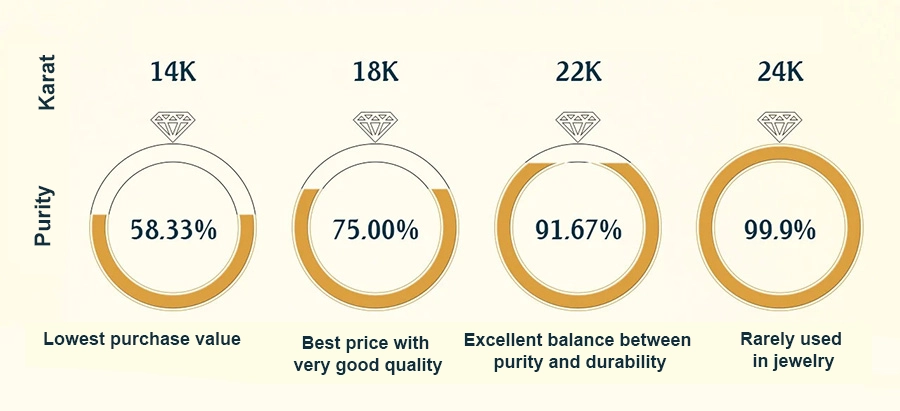
24 Karat: Pure gold with 99.9 percent gold. Soft and suitable for bullion and investment, but unsuitable for jewelry due to its vulnerability.
22 Karat: Contains 91.67 percent gold. Common in India and Arab countries, has a deep yellow color, and is used for traditional jewelry.
18 Karat: Contains 75 percent gold. The standard in Europe, offering a good balance between purity and durability, and ideal for everyday jewelry.
14 Karat: Contains 58.33 percent gold. Popular in the United States, durable and more affordable, suitable for daily wear jewelry.
10 Karat: Contains 41.67 percent gold. The least expensive type, often used in low-cost jewelry.
In addition, lower karats such as 9 or 8 may also exist in some countries.
The main difference among karat types lies in the purity percentage, which affects color, hardness, and price. For example, higher karat gold has a deeper yellow color and greater brilliance, while lower karat gold may appear paler.
Comparison Table
To better understand the differences between gold karats, we have prepared a table showing the purity percentage, uses, and the advantages and disadvantages of each karat. This table is compiled based on international standards.
| Gold Karat | Pure Gold Ratio | 3-Digit Code Gold Content per 1000 Units |
Gold Purity Percentage |
|---|---|---|---|
| 6 | 6/24 | 250 | 25% |
| 8 | 8/24 | 333 | 33.3% |
| 9 | 9/24 | 375 | 37.5% |
| 10 | 10/24 | 417 | 41.7% |
| 12 | 12/24 | 500 | 50% |
| 14 | 14/24 | 583 | 58.3% |
| 15 | 15/24 | 625 | 62.5% |
| 18 | 18/24 | 750 | 75% |
| 20 | 20/24 | 833 | 83.3% |
| 21 | 21/24 | 875 | 87.5% |
| 22 | 22/24 | 916 | 91.6% |
| 24 | 24/24 | 999 | 99.9% or higher |
The Effect of Karat on Price & Purity
Karat directly affects both the price and purity of gold. Higher purity means a greater amount of gold in the alloy, which results in a higher price. For example, the price of one gram of 24 karat gold is higher than that of 18 karat gold because it contains more pure gold.
Of course, other factors such as manufacturing costs, taxes, and market fluctuations also play a role, but karat is the primary basis. For investment purposes, higher karat gold yields greater long-term returns because it has higher intrinsic value. However, for jewelry, lower karat gold is more economical because it is more durable and requires lower repair costs.
Gold Karat in Different Countries Around the World
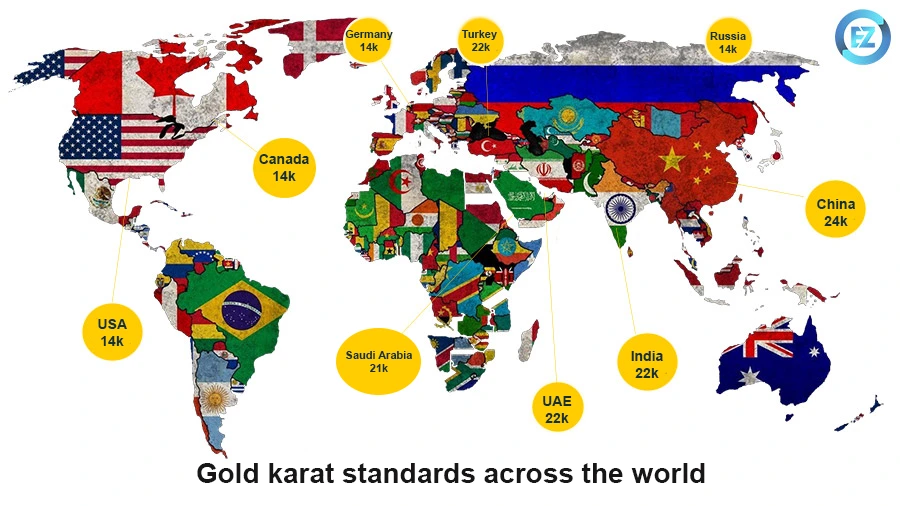
Gold karat varies across countries depending on culture, regulations, and economic needs. In Asia and the Middle East, higher karats are common, while in Western countries, lower karats are preferred for greater durability. In the following sections, we examine gold karats used in specific countries.
Gold Karat in Turkey
In Turkey, 22 karat (916) is the standard and is used for traditional jewelry. Turkey is one of the largest gold producers, and 14 and 18 karat gold are also common. Strict regulations exist for hallmarking karat to ensure purity. Turkish gold is often alloyed with copper to give it a deep yellow color.
Karat in the United States & Canada
In the United States, 10, 14, and 18 karat gold are predominant. Fourteen karat (583) is the most popular because it offers a good balance between price and durability. FTC regulations require karat marking, and gold below 10 karat is not legally considered “gold.” Americans prefer lower-karat white gold for jewelry.
Canada is similar to the United States, using karats from 10 to 18. Fourteen karat is the standard, with a strong focus on mined gold. Canadian regulations also require karat marking.
Gold in Germany
Germany uses gold karats ranging from 8 to 18, but 14 karat (585) is the standard. The emphasis is on high quality and durability. German gold is often alloyed with silver, and hallmarking is mandatory. In Europe, Germany is a leader in karat standards.
Gold Karat in the UAE
In the UAE (Dubai), 21, 22, and 24 karat gold are common. Dubai is a major gold trading hub, and 22 karat (916) is especially popular for Arabic jewelry. Dubai’s regulations guarantee karat accuracy, and the Deira Gold Souk is one of the largest gold markets in the world.
Common Karats in Thailand & India
Thailand uses 23 karat gold (96.5 percent), which is unique. Thai gold is often produced for export, and its high karat gives it a bright yellow color. The gold industry in Thailand is advanced, and 18 karat gold is also used.
India has 22 karat (916) as its standard. As the largest consumer of gold, India prefers high-karat gold for its many ceremonies. BIS regulations control karat standards, and the use and popularity of 18 karat gold are increasing.
Common Karat in Saudi Arabia
Saudi Arabia commonly uses 21 karat (875) gold. Saudi gold is intended for traditional jewelry, and higher karat holds cultural value. The gold market in Saudi Arabia is competitive, and 22 karat gold is also used.
Gold Karat in Afghanistan
In Afghanistan, 21 and 22 karat gold are common. The market is traditional, and high-karat gold is used for investment. Economic challenges have affected standardization, but 18 karat gold also exists.
How Is It Identified?
Identifying gold karat is one of the most important steps in buying, selling, and even determining the true value of jewelry and bullion. Correct karat identification not only helps prevent financial loss but also ensures the authenticity of the gold. Below, we explain all common and scientific methods of identifying gold karat in a complete and practical way.
Checking the Hallmark or Engraved Code on Gold (Simplest Method)
All standard jewelry should have a karat hallmark.
The most important standards include:
- 750 = 18 karat gold
- 585 = 14 karat gold
- 916 = 22 karat gold
- 999 = 24 karat gold
- 375 = 9 karat gold
This method is fast, accurate, requires no tools, and allows you to identify the karat at home. However, its drawback is that hallmarks can be forged, and older gold items may not have a stamp.
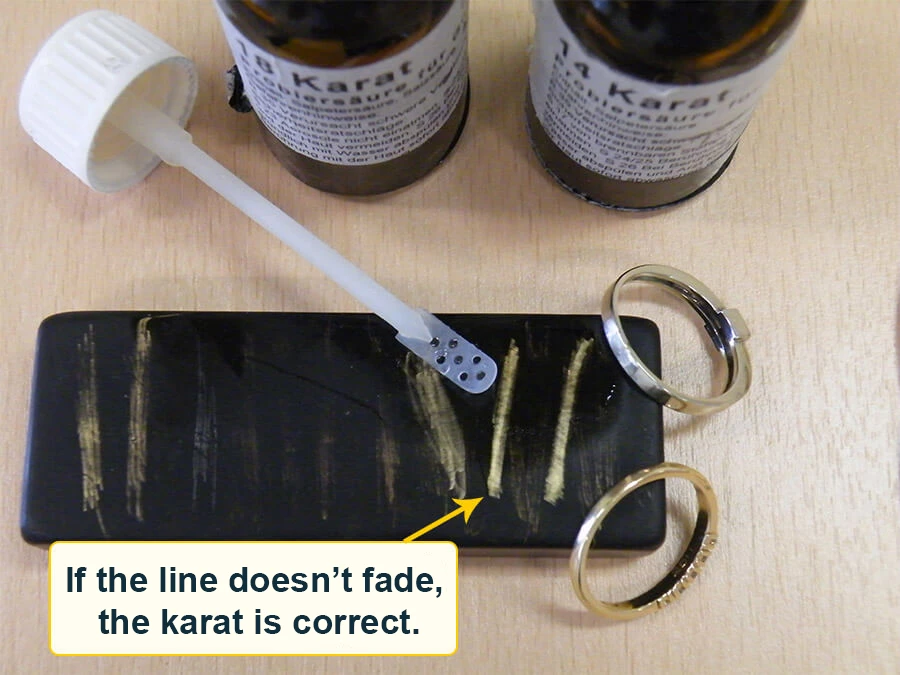
Touchstone Test
This method dates back thousands of years and is still one of the standard tools used by jewelers. The test is performed as follows:
- The gold piece is rubbed on a touchstone.
- A gold streak remains on the stone.
- A few drops of acid specific to different karats are applied to the streak.
- Based on the acid’s reaction, the gold’s karat is determined.
Acid Test
The acid test is a common and low-cost method for identifying genuine gold and determining its karat.
Types of acids include:
- Acid for 10 karats
- Acid for 14 karats
- Acid for 18 karats
- Acid for 22 karats
In this method, a drop of acid is applied to a small area of the gold and the color reaction is observed.
Dullness, green discoloration, or bubbling: The item is not gold or has a lower karat.
No change: The karat is equal to or higher than the acid used.
The acid test is accurate and very affordable for jewelers, but it causes slight surface damage and requires basic knowledge, so there is still a risk of error.
Using an XRF Device
The XRF device is the most advanced and accurate tool for measuring gold karat and is used in assay offices and laboratories.
By emitting X-rays onto the metal, the device analyzes its elemental composition and displays the exact percentage of gold and alloys (such as silver, copper, and nickel), with accuracy close to 100 percent. The key advantage is that it delivers fast results without damaging the gold.
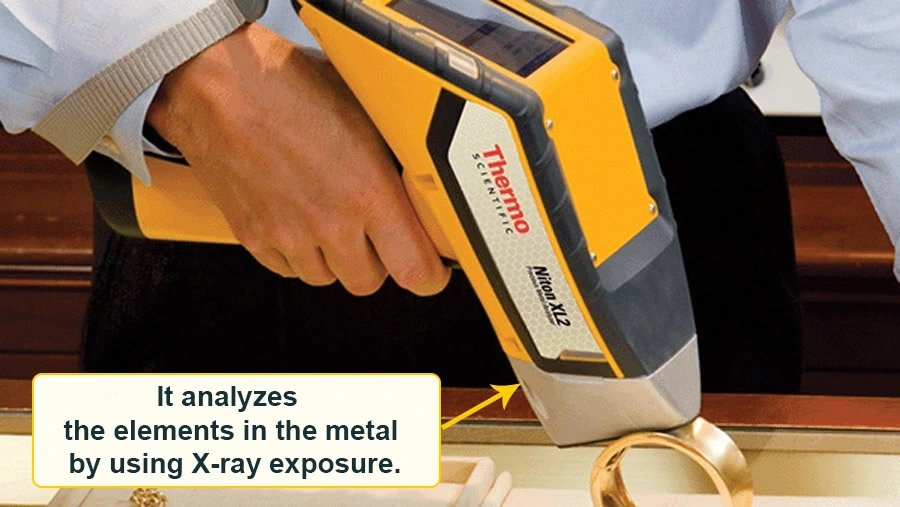
Karat identification of bullion, analysis of molten gold, and quality control in reputable jewelry stores are performed using XRF devices.
Identifying Karat by Gold Color
Pure gold (24 karat) has a very bright and deep yellow color. As karat decreases, the color becomes paler and duller.
- 18 karats: Softer yellow
- 14 karats: Pale yellow with white or copper tones
- 10 karats: Duller, less transparent color
This method is not very simple and is more suitable for experienced individuals, as not everyone can accurately distinguish color differences.
Measuring Gold Weight and Density
The density of pure gold is 19.3 g/cm³.
The steps are straightforward:
- Measure the gold’s weight using a precise scale.
- Determine its volume by submerging it in water.
- Divide the weight by the volume.
- Compare the result with the gold density chart.
This method is also scientific and accurate.
Also Read: Gold Ounce to Grams
Best Gold Karat for Investment
After understanding the general concept, many investors or buyers ask which gold karat is best for investment.
As mentioned, gold karat directly affects price, liquidity, making charges, fees, and profit margins. Therefore, knowing the best karat helps you make a lower-risk and more profitable investment.
If your goal is true investment rather than purchasing jewelry, the best choice without a doubt is 24 karat gold, which has the highest purity.
❓ Why is 24 karat gold the best option?
- No making charges
- Very high purity (99.9%)
- Fast and global liquidity
- Suitable for large and long-term purchases
- Can be sold worldwide at standard rates
24-k gold is usually traded in the form of bullion bars, bank-issued coins, or standard molten gold, and is the best option for high-value investments.
Twenty-four karat bars or coins have no making charges and offer high liquidity. In comparison, 18 karat gold is less suitable for investment because part of it consists of other metals.
Molten 24 karat gold is also a good option, but it carries a risk of fraud. In the long term, higher karat gold yields greater returns because gold prices are always calculated based on purity.
Related: Silver Purity Explained
FAQ
What is gold karat?
Gold karat is a unit that indicates the purity of gold in a piece. It shows how much pure gold is mixed with other metals. Pure gold is 24 karats, while lower karats contain a combination of gold and alloys such as copper or silver.
Which gold karat is best for investment?
The best gold for investment is 24 karat gold because it has the highest purity (99.9%), no making charges, and high global liquidity. Gold bars and bullion are usually 24 karat and are ideal for long-term investment.
Which gold karat is best for investment?
The best gold for investment is 24 karat gold because it has the highest purity (99.9%), no making charges, and high global liquidity. Gold bars and bullion are usually 24 karat and are ideal for long-term investment.
Is 24 karat gold better than 18 karat gold?
For investment purposes, 24 karat gold is better because it has higher purity and intrinsic value. However, for jewelry, 18 karat gold is often preferred because it is more durable and resistant to scratches.
Does gold karat affect the price of gold?
Yes, gold karat directly affects the price. Higher karat gold contains more pure gold, so it is more expensive. For example, 24 karat gold is more valuable than 18 karat gold because it has a higher gold content.
Why is 14 karat gold popular in the USA?
14 karat gold is popular in the United States because it is more durable, affordable, and suitable for everyday jewelry. It contains 58.3% gold and is less likely to bend or scratch compared to higher karats.
What does 750 gold mean?
750 gold means 18 karat gold. Out of 1,000 parts, 750 parts are pure gold (75%).
What karat is gold in Dubai?
Dubai commonly uses 21 and 22 karat gold. The Dubai gold market offers high-karat gold for tourists.
What is the gold karat in Europe?
In Europe, 14 to 18 karat gold is common. Germany and France use 18 karats as the standard, while the United Kingdom uses gold ranging from 9 to 22 karat.
Latest in Gold Tutorials
All articles in this category