Making Money with Gold Arbitrage: A Guide to Opportunities, Risks, and Strategies

 Krishna
 Published:
 Updated:
 Read time:9 Minutes
Table of contents
Gold prices have remained elevated throughout 2025 and into 2026, driven by central bank buying, geopolitical uncertainty, and shifting physical demand between major hubs. While most traders focus on guessing the next direction of gold, a smaller group of market participants quietly profits from temporary price gaps that appear across different platforms, instruments, and time zones. This practice is known as gold arbitrage.
What is Gold Arbitrage?
Gold arbitrage refers to the process of simultaneously buying and selling gold-related instruments to capture risk-free or low-risk profits from price discrepancies.
These discrepancies can last only a few seconds or minutes, yet they occur frequently enough in the XAUUSD market and gold futures to attract both retail traders using expert advisors and institutional desks with sophisticated infrastructure. The combination of high volatility, wide spreads on certain brokers, and ongoing physical gold flows between London and New York has created particularly attractive conditions for several forms of gold arbitrage.
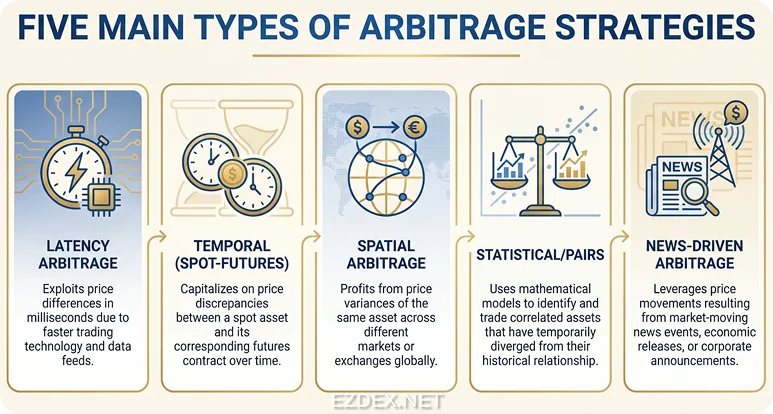
Main Types of Arbitrage in Gold Trading
Not all arbitrage is the same. Understanding the different categories helps traders choose the right approach based on their circumstances. Here are the primary types relevant to gold:
Latency Arbitrage: This strategy exploits the time delay between a fast institutional price feed and a slower retail broker’s quote. When gold moves sharply on news or during the London or New York open, the fast feed updates first. The trader places an order on the slower broker before it adjusts its price. Gold’s high volatility and news sensitivity make latency arbitrage especially effective on XAUUSD, although modern brokers have become better at detecting it.
Temporal Arbitrage (Spot vs Futures / Basis Trading): Also called cash-and-carry or EFP arbitrage, this involves taking opposite positions in the physical spot market (or XAUUSD) and gold futures. When the futures price deviates significantly from the theoretical fair value based on interest rates and storage costs, traders can lock in the difference. In 2026, the ongoing physical gold movement from London to New York has widened these spreads at times, creating measurable opportunities for basis traders.
Spatial or Geographic Arbitrage: This older form of arbitrage takes advantage of price differences for physical gold or gold products across locations or jurisdictions. Examples include buying gold jewelry or bars in one country where premiums are low and selling in another where demand drives higher prices. While less common for screen-based traders, it still appears in discussions around India, Turkey, and certain Middle Eastern markets. Purity, transport costs, and regulatory hurdles usually limit scalability.
Read More: in which country gold is cheapest?
Statistical and Pairs Arbitrage: Traders monitor the historical relationship between gold and correlated assets such as silver (gold-silver ratio) or between XAUUSD and other currency pairs. When the spread deviates beyond normal statistical ranges, they enter mean-reversion trades expecting the relationship to normalize. This approach is market-neutral and works well during ranging or moderately volatile periods.
News and Event-Driven Arbitrage: Gold reacts violently to U.S. economic data releases, FOMC decisions, and geopolitical headlines. Some traders use pending orders or fast execution systems to capture the immediate price reaction across multiple brokers or between spot and futures before full liquidity returns. While closer to directional trading than pure arbitrage, the short time frame and hedging elements keep it within the broader arbitrage family.
Each of these types requires different tools, capital, and risk controls.

How Gold Arbitrage Works
Successful gold arbitrage follows a clear, repeatable process regardless of the specific strategy. The entire cycle usually completes in milliseconds to a few seconds. Here is the standard pipeline professional traders use:
- Receive fast reference price — A low-latency feed (such as CME GC futures via CQG, Rithmic, or LMAX) delivers the true market price first.
- Compare with execution venue — The system continuously checks the slower broker quote (XAUUSD on a retail platform) against the fast feed.
- Detect divergence — When the price gap exceeds a predefined threshold (often measured in cents or pips), the algorithm flags an opportunity.
- Execute the trade — Buy on the cheap venue and sell on the expensive venue (or vice versa) almost simultaneously.
- Hedge or exit — The position is either immediately closed when prices converge or hedged with an opposing trade until convergence occurs.
- Apply risk controls — Automatic stop-losses, maximum daily loss limits, and kill-switches protect capital during unexpected gaps or news spikes.
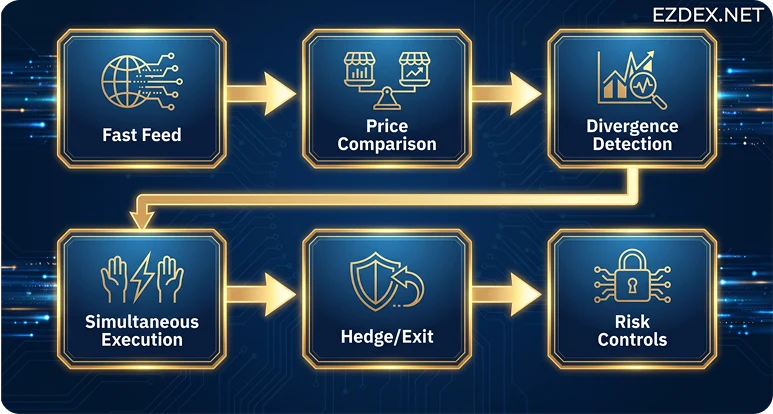
Gold’s large average true range and sharp reactions to macroeconomic news make every step of this pipeline more profitable than in major currency pairs.
Latency Arbitrage on XAUUSD: The Dominant Retail Strategy
Latency arbitrage remains the most widely used form of gold arbitrage among retail and semi-professional traders. It capitalizes on the delay between a high-quality institutional data feed and the slower price updates of many retail forex brokers.
Why Gold Excels for Latency Arbitrage?
XAUUSD typically moves 30–80 cents during normal sessions and 150–400 cents during major news releases. These large, fast moves create bigger price gaps between feeds than EURUSD or GBPUSD. In addition, gold’s high liquidity ensures that once the slow broker updates, the trade can usually be closed quickly with minimal slippage.
How Latency Arbitrage Works in Practice
A trader connects to a fast feed (for example, CME gold futures) and simultaneously monitors one or more retail brokers offering XAUUSD. When the fast feed shows gold jumping 120 cents on better-than-expected U.S. data, the retail broker may still be showing the old price for 80–300 milliseconds. The system buys or sells on the retail platform before the quote catches up. Once the broker updates, the position is closed for a small but repeatable profit per trade.
Key Technical Requirements
- Fast data feed (CQG, Rithmic, or equivalent)
- Low-latency VPS or colocation near major liquidity hubs (LD4 London, NY4 New York)
- Arbitrage software or Expert Advisor capable of comparing feeds in real time
- Multiple broker accounts to rotate volume and reduce detection risk
Realistic Profitability Expectations
On a well-tuned setup, traders commonly target 30–120 cents per trade with 0.10–0.50 lot size. With 50–150 trades per day during active sessions, monthly returns of 8–20% on allocated capital are frequently reported by verified accounts, although these figures assume excellent infrastructure and strict risk management. Performance drops sharply if the broker introduces delays or widens spreads in response to the activity.
Risks Specific to Latency Arbitrage
The biggest threat is broker detection and subsequent account restrictions or widened spreads. Other risks include weekend gaps (gold can move 200–800 cents between Friday close and Sunday open), news-related slippage, and feed disconnections during volatile periods. Professional setups always include automatic position flattening before high-impact events and daily loss limits of 1–2% of capital.
Latency arbitrage works best for traders who can invest in proper infrastructure and are willing to adapt quickly when brokers change their quoting behavior. In the next section, we examine spot-versus-futures arbitrage, which requires less speed but more analytical precision and is currently benefiting from the 2026 physical gold flows between London and New York.
Spot vs Futures Arbitrage
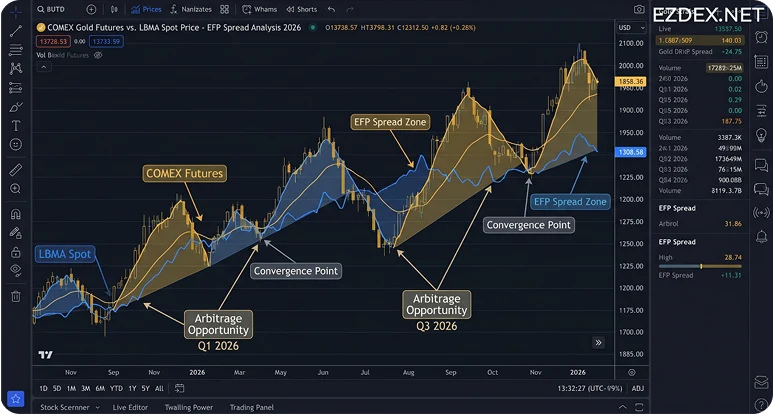
Spot-versus-futures arbitrage, also known as basis trading or EFP arbitrage, is one of the most established forms of gold arbitrage. It exploits the difference between the London spot price (LBMA) and gold futures prices on COMEX. In 2026, this strategy has gained renewed attention because physical gold has been flowing from London vaults to New York, causing futures to trade at a persistent premium to spot for extended periods.
The core idea is simple: when the futures price deviates from its theoretical fair value relative to spot, a trader can take offsetting positions and lock in the difference as prices converge. This approach is market-neutral and does not require ultra-low latency infrastructure, making it accessible to a wider range of traders.
How to Identify Opportunities
The fair value of a gold futures contract is calculated using the spot price plus the cost of carry (interest rates minus lease rates plus storage). When actual futures prices move significantly above or below this fair value, an arbitrage window opens. In recent months, the EFP spread has widened beyond normal ranges during periods of strong physical demand in the United States, creating measurable profit potential.
Practical Example
Suppose LBMA spot gold trades at $2,650 per ounce while the nearest COMEX futures contract trades at $2,680. If the theoretical fair value based on current interest rates and lease rates is approximately $2,655, the futures are overpriced by about $25. A trader can:
- Sell the futures contract at $2,680
- Buy an equivalent amount of spot gold (or XAUUSD) at $2,650
- Hold the position until the spread narrows or the contract expires
The $25 difference, minus transaction costs and financing, represents the locked-in profit. In 2026 market conditions, spreads of $15–$40 have appeared frequently enough to make this strategy attractive for accounts with $50,000+ in capital.

Advantages of Spot-Futures Arbitrage
- Lower speed requirements compared with latency strategies
- Clear mathematical edge based on observable spreads
- Benefits from current physical gold migration trends
- Can be executed with futures accounts or through brokers offering both spot and futures products
Challenges and Risks
This strategy requires sufficient margin for futures positions and careful management of rollover costs when holding positions across contract expirations. Weekend gaps and sudden changes in physical demand can temporarily widen spreads further before they converge. Traders also need reliable data for accurate fair-value calculations and must monitor Exchange for Physical (EFP) transactions that institutions use to arbitrage the same spread.
Lock and Two-Broker Hedge Arbitrage
Lock arbitrage, sometimes called two-broker hedge arbitrage, involves opening simultaneous long and short positions on the same gold instrument across two different brokers or accounts. The goal is to exploit small, temporary pricing differences or to create a market-neutral position that profits from convergence while minimizing directional risk.
This strategy is particularly popular among traders who want lower detection risk than pure latency arbitrage. Because positions are hedged, the overall market exposure remains close to zero, and profits come from the spread between the two execution venues rather than from gold price movement.
How Lock Arbitrage Works on XAUUSD
Trader A buys 1 lot of XAUUSD on Broker X at 2,652.40 while simultaneously selling 1 lot on Broker Y at 2,653.10. The 70-cent difference is locked in. When the quotes converge or when the trader decides to close both sides, the net profit (minus commissions and swap) is realized regardless of whether gold rises or falls. Advanced versions use virtual orders, partial hedging, and multiple account structures (such as BrightDuo or tri-account setups) to increase efficiency and reduce margin usage.
Why Gold Is Well-Suited for Lock Arbitrage
Gold’s wide average spreads on many retail platforms and its tendency to show temporary mispricings between brokers during news or session opens create frequent small edges. Unlike major forex pairs, XAUUSD often maintains enough spread differential to make the strategy viable even after costs. In 2026, increased volatility has further expanded these opportunities.
Technical and Operational Requirements
Successful lock arbitrage demands:
- At least two (preferably three or more) execution accounts with brokers that allow hedging
- Fast and stable connectivity between accounts
- Software capable of simultaneous order placement and real-time spread monitoring
- Careful margin and swap management, especially when holding positions overnight
- Clear rules for when to enter, scale, or exit the locked position
Many traders combine lock arbitrage with elements of latency strategies, using one fast feed to decide entry timing while keeping the hedged structure for protection.
Risks and Limitations
The main challenges include broker policies that prohibit or restrict hedging, differences in swap rates between brokers, and the capital tied up in opposing positions. Some platforms have introduced rules against “virtual arbitrage” or multi-account hedging. Traders must also monitor for asymmetric slippage, where one broker fills quickly while the other lags. Strict daily loss limits and automatic position flattening before weekends are essential.
Lock arbitrage offers a more stable but lower-frequency profit profile compared with pure latency trading. It works especially well for traders who prefer a market-neutral approach and can manage multiple accounts efficiently.
Realistic Profitability & Capital Requirements
Gold arbitrage can generate attractive returns, but expectations must remain grounded in real market conditions. Profitability varies significantly depending on the strategy, infrastructure quality, broker relationships, and risk management discipline. The figures below reflect aggregated observations from verified trading accounts and professional setups operating in the current environment.
Typical Performance Ranges by Strategy
| Strategy | Minimum Recommended Capital | Realistic Monthly Return | Risk Level | Risk Level | Notes |
|---|---|---|---|---|---|
| Latency Arbitrage | $15,000 – $30,000 | 8 – 18% | Medium-High | 50 – 200 per day | Requires fast infrastructure |
| Spot vs Futures (Basis/EFP) | $50,000 – $150,000 | 5 – 12% | Low-Medium | 5 – 30 per week | Benefits from 2026 physical flows |
| Lock / Two-Broker Hedge | $25,000 – $60,000 | 6 – 14% | Medium | 10 – 60 per day | More stable, lower detection risk |
| Combined Multi-Strategy | $75,000+ | 10 – 20% | Medium | Varies | Best risk-adjusted profile |
These returns assume professional-grade execution and strict risk rules. Many retail traders achieve lower results due to poor infrastructure, emotional decision-making, or broker restrictions. The higher end of the range (15–25%) is usually seen only in well-optimized, multi-strategy setups with several years of experience.
Capital Allocation Guidelines
Most professionals recommend starting with capital that allows meaningful position sizes while keeping risk per trade under 0.5–1% of total equity. For latency strategies, smaller accounts can work but often suffer from higher relative costs and broker scrutiny. Spot-futures arbitrage generally requires larger accounts because of futures margin requirements and the need to hold positions longer.
It is common to allocate capital across 2–3 different strategies and multiple brokers. This diversification reduces the impact if one broker detects activity or temporarily widens spreads.
Key Risks in Gold Arbitrage
While gold arbitrage is often described as low-risk, it is not risk-free.

1. Broker Detection and Account Restrictions: The single biggest threat to latency and lock strategies. Brokers monitor for patterns such as high-frequency hedging, consistent profits with low drawdown, or trading only during news.
Mitigation: Rotate volume across multiple brokers, add random delays, run diversionary strategies, avoid trading the first 30–60 seconds of major releases, and never discuss specific setups publicly.
2. Slippage and Weekend/News Gaps: Gold can gap 200–800 cents between Friday close and Sunday open or during surprise geopolitical events. Latency strategies are especially vulnerable.
Mitigation: Flatten all positions before weekends and high-impact news (NFP, CPI, FOMC). Use hard daily loss limits and automatic kill-switches.
3. Over-Leverage and Margin Calls: High leverage combined with hedged positions can still trigger margin issues during extreme volatility or when one broker’s margin calculation differs.
Mitigation: Keep overall leverage conservative (especially on futures). Monitor margin usage in real time and maintain excess equity buffers.
4. Feed Disconnections and Technical Failures: A dropped fast feed or VPS outage during a volatile move can turn a profitable setup into a losing one.
Mitigation: Use redundant feeds and backup VPS instances. Implement automatic position flattening if feed latency exceeds a set threshold.
5. Regulatory and Platform Policy Changes: Some jurisdictions or brokers may introduce new rules restricting certain arbitrage practices.
Mitigation: Trade only with well-regulated brokers, keep detailed records, and diversify across different regulatory environments when possible.
6. Psychological and Operational Risks: Over-optimization, revenge trading after a losing streak, or neglecting ongoing monitoring can destroy an otherwise sound system.
Mitigation: Treat arbitrage as a business. Use written rules, regular performance reviews, and third-party verified tracking for accountability.
Professional gold arbitrage traders view risk management as the real edge. Even the best price discrepancy disappears if execution fails or capital is lost to uncontrolled gaps. Strict daily and weekly loss limits, position sizing rules, and regular infrastructure testing are non-negotiable.
With realistic expectations and robust risk controls in place, the next logical step is understanding exactly how to set up and execute your first gold arbitrage trade safely. The following section provides a practical, step-by-step framework suitable for both latency and basis strategies.
Step-by-Step Guide to Setting Up Your First Gold Arbitrage Trade
Moving from theory to practice requires a structured approach. Below is a practical framework that works for both latency arbitrage and spot-futures basis trading. Follow the steps in order and never skip the risk and testing phases.
Step 1: Define Your Strategy and Capital
Decide which type of gold arbitrage matches your resources.
- Latency arbitrage for smaller capital, high-speed infrastructure required.
- Spot-futures (EFP/basis) for larger capital, moderate speed, focus on spread analysis.
- Lock/hedge arbitrage for medium capital, multiple broker accounts.
Allocate only risk capital you can afford to lose while learning. Start with 1–2% maximum risk per trade or per day.
Step 2: Choose and Verify Your Brokers
Select 2–4 brokers that meet the criteria discussed earlier (slow quotes during volatility, hedging allowed, good execution). Open and fully verify accounts (KYC). Fund them and test small manual trades during low-volatility hours to confirm execution quality and withdrawal processes.
Step 3: Set Up Infrastructure
- Install a reputable VPS or colocation service near major liquidity centers.
- Connect a fast reference feed (CME GC futures recommended for gold).
- Install trading platform(s) — MetaTrader 5 or cTrader are most common for retail gold arbitrage.
- Test ping times and feed stability for at least 48 hours before going live.
Step 4: Install and Configure Software
For latency or lock strategies, install or build an Expert Advisor (EA) or custom bot that can:
- Compare fast feed vs broker quotes in real time
- Calculate spread thresholds
- Place simultaneous or near-simultaneous orders
- Apply automatic risk rules (daily loss limit, max positions, news filter)
For spot-futures arbitrage, you may use a combination of futures trading software and a spreadsheet or simple script for fair-value calculations. Backtest any automated system on at least 3–6 months of historical gold data, including major news events.
Step 5: Implement Risk Management Rules
Before placing any live trade, define and code (or manually enforce) these rules:
- Maximum daily loss limit (example: 1.5% of account)
- Maximum number of concurrent positions
- Automatic position flattening 30–60 minutes before high-impact news and before weekends
- Kill-switch that closes all positions if feed latency exceeds a set threshold
- Detailed trading journal (entry time, spread captured, broker used, reason for exit)
Step 6: Start Small and Monitor Closely
Begin with the smallest lot size your broker allows (often 0.01). Trade only during the most liquid sessions (London open to New York overlap). Monitor every trade manually for the first 1–2 weeks even if using automation. Track actual slippage, execution speed, and any broker warnings.
Step 7: Scale Gradually and Diversify
Once you have 30–50 profitable trades with consistent execution and no broker issues, slowly increase position size. Add a second or third broker and consider running a second strategy (for example, combining latency with occasional basis trades). Never increase size after a winning streak without reviewing performance data first.
Step 8: Regular Review and Optimization
Review performance weekly. Key metrics to track:
- Average profit per trade
- Win rate and profit factor
- Maximum drawdown
- Broker response times and any spread widening patterns
- Infrastructure uptime
Adjust thresholds, broker rotation, or risk parameters based on real results. Markets and broker behavior change, so continuous adaptation is essential.
Following this step-by-step process dramatically increases the chances of building a sustainable gold arbitrage operation rather than suffering early account restrictions or unnecessary losses.
Related: Gold Swing Trading Explained
Gold Arbitrage FAQ
What is gold arbitrage?
Gold arbitrage is the practice of exploiting temporary price differences in gold-related instruments (XAUUSD, futures, or across brokers) to generate low-risk profits. It includes latency, spot-futures, lock, and pairs strategies.
Is gold arbitrage legal?
Yes, arbitrage itself is legal in most jurisdictions. However, some brokers prohibit specific practices such as latency arbitrage or multi-account hedging in their terms of service. Always review broker policies and trade only with platforms that explicitly allow your intended strategy.
How much capital do I need to start?
Realistic minimums range from $15,000 for basic latency setups to $50,000+ for spot-futures arbitrage. Smaller accounts can work but face higher relative costs and greater broker scrutiny.
Is gold arbitrage still profitable in 2026?
Yes. The combination of elevated gold prices, physical gold flows between London and New York, and persistent feed differences on retail platforms continues to create opportunities. Returns of 5–18% per month are achievable with proper infrastructure and risk management, though results vary widely.
What is the difference between latency arbitrage and spot-futures arbitrage?
Latency arbitrage exploits quote delays between fast feeds and slower brokers (high frequency, requires speed). Spot-futures arbitrage exploits pricing gaps between LBMA spot and COMEX futures (lower frequency, benefits from physical market imbalances).
Which brokers are best for gold arbitrage?
Look for brokers with slower quote updates during volatility, allowance for hedging, fast execution, and supportive API/EA policies. Many professionals use 3–6 different brokers and rotate activity.
What are the biggest risks?
Broker detection and account restrictions, slippage during news or gaps, technical failures, and over-leverage. Strict daily loss limits and position flattening before high-risk periods are essential.
Can I do gold arbitrage with a small account under $10000?
It is possible but difficult. Smaller accounts usually achieve lower returns after costs and face higher risk of broker restrictions. Most professionals recommend starting with at least $15000–$25000.
How long does it take to set up a working system?
Expect 4–8 weeks for infrastructure, broker verification, EA testing, and rule development before going live with meaningful capital.
Latest in Gold Tutorials
All articles in this category