Swing Trading Gold in 2026: The Ultimate XAU/USD Strategy Guide for Consistent Profits
 Krishna
 Published:
 Updated:
 Read time:8 Minutes
Table of contents
Swing trading gold offers one of the most effective ways to capture significant price moves in the XAU/USD market without the intense pressure of day trading. In 2026, with gold trading around the $4,300 level amid shifting macroeconomic conditions, traders who master structured swing trading strategies can position themselves for consistent profits while maintaining better work-life balance.
If you have ever felt overwhelmed by constant screen time or missed major gold trends because you could not watch the charts 24/7, swing trading gold provides the perfect middle ground. This comprehensive guide covers everything you need to know about XAU/USD swing trading strategies, from understanding market drivers to executing high-probability setups with professional risk management.
Important Disclaimer: Trading gold and other financial instruments involves substantial risk of loss and is not suitable for all investors. Past performance is not indicative of future results. This article is for educational purposes only and does not constitute financial advice. Always do your own research and consider consulting a qualified financial advisor.
What Is Swing Trading Gold and Why It Works
Swing trading gold involves holding positions for several days to a few weeks to profit from “swings” or directional price movements within the broader trend.
Unlike day trading, which requires constant monitoring, or long-term investing, which can tie up capital for months or years, XAU/USD swing trading strikes an ideal balance.
Gold’s unique characteristics make it particularly well-suited for swing trading:
- High liquidity with daily trading volumes often exceeding $180 billion
- Clear technical patterns and strong reactions to macroeconomic news
- Average daily ranges of 120–180 pips that create meaningful profit opportunities
- Strong trending behavior driven by interest rates, USD strength, and global risk sentiment
Many traders find that swing trading gold reduces emotional stress while still delivering attractive risk-to-reward ratios, often targeting 1:2 or 1:3 setups.
Why Gold Remains One of the Best Assets for Swing Traders in 2026
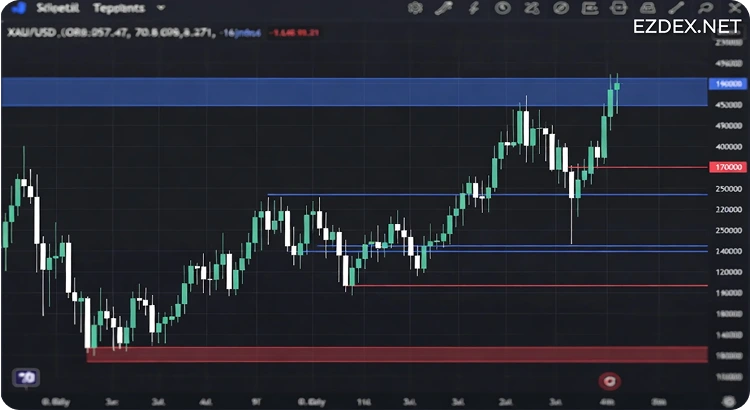
Gold continues to attract both institutional and retail traders because it serves as a hedge against inflation, currency weakness, and geopolitical uncertainty. In 2026, central banks are still accumulating gold at a strong pace, supporting the longer-term bullish structure even during short-term corrections.
Swing traders benefit from gold’s tendency to move in extended trends punctuated by clear pullbacks. These pullbacks create excellent entry opportunities when combined with proper technical confirmation.
Key Macroeconomic Drivers That Move Gold Prices
Successful XAU/USD swing trading requires understanding what drives gold beyond pure technical analysis. The strongest moves often occur when technical setups align with fundamental catalysts.
Interest Rates, US Dollar & Real Yields
Gold typically rises when real interest rates fall or when expectations for rate cuts increase. A weaker US Dollar also supports higher gold prices because gold becomes cheaper for foreign buyers. Monitoring the DXY (US Dollar Index) and 10-year Treasury yields provides valuable context for swing trade direction.
Geopolitics, Central Bank Demand & Risk Sentiment
Periods of heightened geopolitical tension or market fear usually drive safe-haven buying into gold. Central bank purchases, which have remained robust into 2026, provide structural support during dips. Swing traders who stay aware of these macro themes can avoid fighting the dominant trend.
Best Timeframes for XAU/USD Swing Trading
Choosing the right timeframes is one of the most important decisions in swing trading gold. The goal is to identify the dominant trend on higher timeframes while finding precise entry points on lower timeframes.
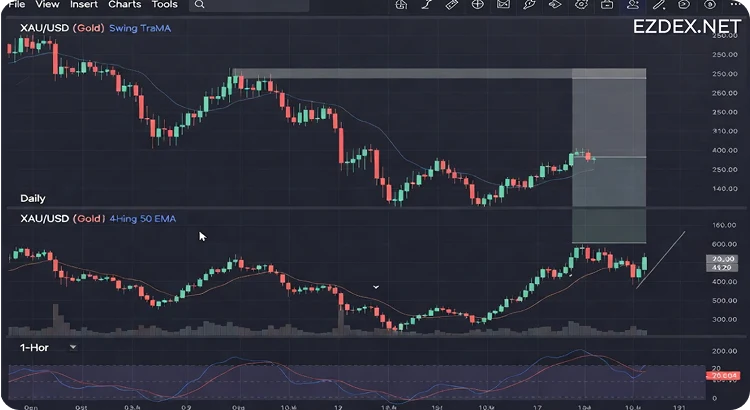
Daily and 4-Hour Charts for Direction and Structure
Most successful XAU/USD swing traders start their analysis on the Daily chart. This timeframe reveals the primary trend, major support and resistance zones, and overall market structure. Gold tends to respect key daily levels well because of the high volume and institutional participation.
The 4-hour chart serves as the sweet spot for swing trading gold. It filters out much of the intraday noise while still providing enough detail to spot high-probability setups. Many traders use the 4H chart to identify pullbacks within the daily trend and to time their entries.
Lower Timeframes for Precise Entries
Once you have the higher-timeframe bias, drop down to the 1-hour or 30-minute chart for entry confirmation. Look for reversal candlestick patterns, breaks of minor structure, or confluences with indicators at key levels identified on the higher timeframes.
Pro Tip: Never take a swing trade against the daily trend unless you have very strong confluence and are prepared for wider stops. Fighting the higher-timeframe direction is one of the fastest ways to lose money in gold swing trading.
Essential Technical Indicators for Gold Swing Trades
While price action and market structure should always come first, certain indicators provide excellent confirmation when used correctly in XAU/USD swing trading strategies.
Moving Averages – EMA 21, 50, 200 and Crossovers
The 21-period EMA is particularly popular among gold swing traders because it acts as dynamic support in uptrends and resistance in downtrends. Price often pulls back to the 21 EMA before resuming the trend.
The 50 and 200-period EMAs help identify the bigger picture. A bullish Golden Cross (50 EMA crossing above 200 EMA) on the daily chart signals strong trend continuation potential for long swing trades. The opposite Death Cross warns of potential bearish swings.
Momentum Tools: MACD, RSI and Stochastic
MACD is excellent for spotting shifts in momentum on the 4H and daily charts. Look for MACD histogram divergences or signal line crossovers that align with price action at key levels.
RSI helps identify overbought or oversold conditions, but in strong trends it can stay overbought or oversold for extended periods. Use RSI divergences (especially on the daily chart) as early warnings of potential swing reversals rather than standalone signals.
Stochastic works well for timing entries during pullbacks in a trending market. When the Stochastic crosses upward from oversold territory near a support level or EMA, it often provides a high-probability long entry for swing trading gold.
Volatility & Price Action Tools: ATR, Bollinger Bands and Candlestick Patterns
ATR (Average True Range) is essential for setting realistic stop losses in gold. Because gold can be volatile, placing stops at 1.5× to 2× the daily ATR helps avoid being stopped out by normal noise.
Bollinger Bands help visualize volatility contraction and expansion. Squeeze setups (bands tightening) often precede strong directional moves that are perfect for swing trades.
Candlestick patterns such as engulfing candles, pin bars, and inside bars at key support or resistance levels provide the final confirmation for entries. Always wait for the candle to close before acting.
Proven Swing Trading Strategies for Gold (XAU/USD)
Now that you understand the foundation of swing trading gold, it is time to explore specific, battle-tested strategies.
These gold swing trading strategies combine price action, indicators, and market structure for high-probability setups.
Trend Pullback Strategy with EMA Confirmation
This is one of the most reliable approaches for XAU/USD swing trading.
How to execute:
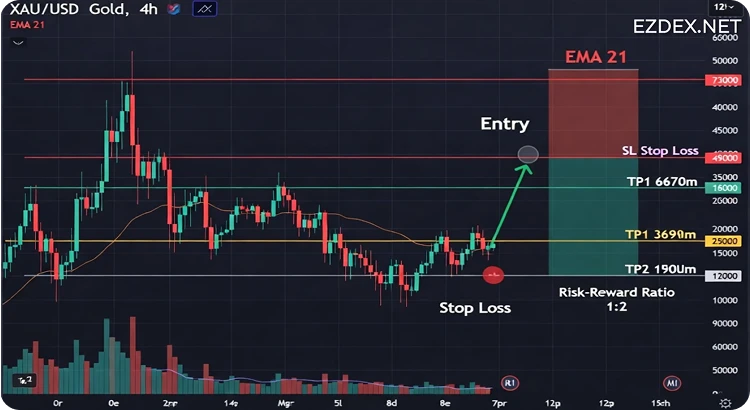
- Identify the dominant trend on the Daily chart using the 21 EMA and market structure (higher highs and higher lows for bullish trend).
- Wait for price to pull back to the 21 EMA on the 4-hour chart.
- Look for bullish confirmation such as a pin bar, engulfing candle, or Stochastic crossover from oversold.
- Enter long when price starts to reject the EMA.
- Place stop loss below the recent swing low or 1.5× ATR.
- Target the previous swing high or use a 1:2.5 risk-reward ratio.
This strategy works exceptionally well in gold because pullbacks to the 21 EMA often act as springboards in strong trends.
Breakout and Retest Setup
Gold frequently consolidates before making strong directional moves. The breakout-retest strategy captures these moves with excellent risk management.
Steps:
- Draw key support and resistance levels on the Daily and 4H charts.
- Wait for a decisive break and close beyond a major level with increased volume or momentum.
- Wait for price to retest the broken level (now acting as support or resistance).
- Enter on confirmation of the retest (bullish candle for upside breakout).
- Stop loss goes on the opposite side of the retest zone.
- Targets are measured using the height of the consolidation or previous swing extensions.
This setup is particularly powerful after major news events when gold breaks out of tight ranges.
Fibonacci Retracement Swing Entries
Fibonacci levels help identify high-probability reversal zones during pullbacks.
How to use it in gold swing trading:
- In an uptrend, draw the Fibonacci retracement from the swing low to swing high.
- Focus on the 50% and 61.8% retracement levels as potential entry zones.
- Combine with EMA confluence or candlestick reversal patterns.
- Enter when price shows rejection at these levels.
- Stop loss below the 78.6% level or recent low.
- Take profits at 161.8% or 261.8% extensions for extended moves.
Fibonacci works well in gold because institutional traders and algorithms often respect these levels during swing moves.
Smart Money Concepts (SMC) for Gold Liquidity Zones
Many professional XAU/USD swing traders now incorporate Smart Money Concepts. The core idea is that large institutions hunt liquidity before reversing price.
Key SMC elements for swing trading gold:
- Identify liquidity pools above recent highs or below recent lows.
- Wait for price to sweep these liquidity levels (stop hunts).
- Look for reversal candlesticks or order block confirmations after the sweep.
- Enter in the opposite direction of the sweep with tight stops.
- Target the next opposing liquidity pool or fair value gap.
SMC adds a powerful layer of confluence, especially during high-impact news periods when gold experiences sharp liquidity grabs.
Heikin Ashi Candles for Riding Extended Trends
Heikin Ashi candles smooth out price action and make it easier to stay in winning swing trades longer.
How to use Heikin Ashi in gold swing trading:
- Switch to Heikin Ashi candles on the Daily or 4H chart.
- In a strong uptrend, look for consecutive green candles with small or no lower wicks.
- Enter or add to long positions during small pullbacks when the trend remains intact.
- Exit or tighten stops when you see a strong reversal candle (large opposite color with long wick).
- Combine with the 21 EMA for additional confirmation.
This method helps traders avoid getting shaken out of profitable XAU/USD swing positions during normal volatility.
Risk Management: Protect Your Capital in Volatile Gold Markets
No discussion of gold swing trading strategies is complete without professional risk management. Gold can move aggressively, so protecting your account is essential for long-term survival.
The 1-2% Rule and Professional Position Sizing
Never risk more than 1-2% of your total trading capital on any single swing trade. Calculate position size based on the distance from entry to stop loss and your account size. This rule ensures you can withstand a string of losses and stay in the game.
Strategic Stop-Loss and Take-Profit Placement
- Use ATR to set logical stops (typically 1.5×–2× daily ATR).
- Place stops beyond obvious swing highs/lows or key levels so normal noise does not trigger them.
- Use partial take-profits: Close 50% at the first target (e.g., previous swing high) and move the stop to breakeven.
- Trail the remaining position using the 21 EMA or ATR trailing stop to capture extended moves.
Managing Positions Through News Events
Major events such as NFP, FOMC decisions, and CPI releases can cause violent moves in gold.
- Reduce position size or close trades before high-impact news.
- Or widen stops significantly if you decide to hold through the event.
- Never hold oversized positions into major announcements unless it is part of a deliberate strategy.
Trading Psychology and Common Mistakes to Avoid
The biggest enemy in swing trading gold is often the trader themselves.
Common pitfalls include:
- Overtrading and taking low-quality setups
- Moving stops further away when a trade goes against you
- Taking profits too early out of fear
- Revenge trading after a loss
- Ignoring the higher-timeframe trend
Solutions:
- Keep a detailed trading journal
- Follow a written trading plan for every swing trade
- Take regular breaks from the charts
- Focus on process over individual trade outcomes
Discipline and patience are what separate consistently profitable gold swing traders from those who eventually blow up their accounts.
Real Examples and How to Backtest Your Strategies
The best way to master these XAU/USD swing trading strategies is through deliberate practice.
Recommended backtesting process:
- Choose one strategy (for example, the EMA pullback).
- Go back 6–12 months on the Daily and 4H charts.
- Mark every valid setup, entry, stop, and target.
- Record win rate, average R:R, and maximum drawdown.
- Only move to live trading after achieving consistent results on demo or historical data.
Many traders use TradingView’s replay feature or MT5 strategy tester for this purpose.
Related: Make money from Gold Arbitrage
Frequently Asked Questions
What is the best timeframe for swing trading gold?
The Daily chart for trend direction and the 4-hour chart for entries and management work best for most traders.
How much should I risk per trade?
Stick to 1% of your account on conservative setups and maximum 2% on high-confluence trades.
Can I swing trade gold during news events?
It is possible but risky. Most traders reduce size or stay out around major releases like NFP or FOMC.
What indicators work best for XAU/USD swing trading?
EMA 21, MACD, RSI divergences, and ATR for stop placement are among the most effective when combined with price action.
How long should I hold a gold swing trade?
Typically, a few days to two or three weeks, depending on the strength of the move and your targets.
Is swing trading gold suitable for beginners?
Yes, but start on a demo account, master one strategy at a time, and always prioritize risk management.
Latest in Gold Tutorials
All articles in this category



Good point on the multi-timeframe approach for gold swing trading—most retail traders skip that layer entirely.