What Is WeChat Pay? How to Set Up and Use WeChat Pay in China
 Krishna
 Published:
 Updated:
 Read time:8 Minutes
Table of contents
Whether you are traveling to China, buying products from a Chinese supplier, or paying for services such as sourcing, logistics, inspection, or manufacturing, WeChat Pay is one of the payment methods you are likely to encounter.
In mainland China, QR-code payments are used across everyday retail, restaurants, transportation, online services, and business transactions. For international users, WeChat Pay can also be useful when a Chinese seller or service provider asks to receive payment through WeChat.
Foreign visitors can link eligible international bank cards to WeChat Pay for supported merchant payments, often without opening a Chinese bank account. International buyers outside China may also encounter suppliers who prefer WeChat Pay for smaller orders, samples, service fees, or quick RMB payments.
This guide explains what WeChat Pay is, how to set it up, how foreigners can use it, how to pay Chinese suppliers, fees and limits, international cards, supplier payments, and how WeChat Pay compares with other payment methods in China.
Quick guide: WeChat Pay is a mobile payment service widely used in China. Foreign travelers can use eligible international cards for supported merchant payments, while international buyers may also use WeChat Pay or dedicated RMB payment services when paying Chinese sellers and service providers.
What Is WeChat Pay?
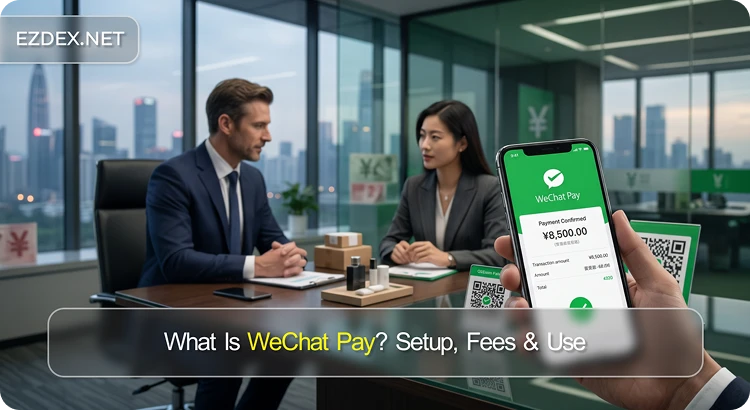
WeChat Pay is a mobile payment service integrated into the WeChat and Weixin ecosystem. It allows users to make payments through QR codes, merchant checkout systems, Mini Programs, and other supported digital payment flows.
Instead of entering card details for every transaction, users can scan a seller's QR code or show their own payment code to complete a purchase.
In China, WeChat Pay is used for a wide range of transactions, including:
- restaurants and cafes
- supermarkets and retail stores
- taxis and transportation
- hotels and travel services
- tourist attractions
- online shopping
- WeChat Mini Programs
- payments to supported merchants
- selected payments for goods and business services
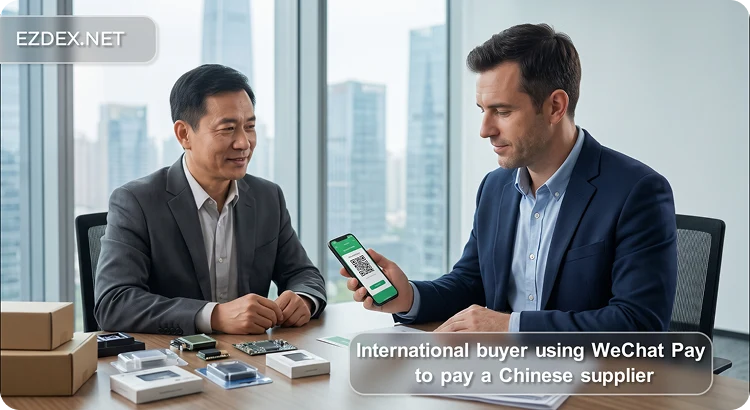
For international buyers, WeChat Pay is especially relevant because some Chinese suppliers, sourcing agents, freight companies, inspection services, and small manufacturers may offer it as a convenient payment option.
WeChat Pay vs Weixin Pay: What's the Difference?
You may see both WeChat Pay and Weixin Pay when dealing with Chinese businesses.
Weixin is the mainland Chinese version of the app, while WeChat is the international brand. Official Chinese-facing materials often use the name Weixin Pay, while international users are more familiar with WeChat Pay.
In practical terms, both names refer to Tencent's broader mobile payment ecosystem.
Who Uses WeChat Pay?
WeChat Pay is useful for two main groups of international users.
The first group is foreign visitors in China who need to pay for restaurants, shopping, transportation, hotels, and other daily expenses.
The second group is international buyers and businesses purchasing from China. These users may need to pay for:
- product samples
- wholesale goods
- sourcing fees
- inspection services
- manufacturing services
- logistics or freight charges
- small supplier invoices
- deposits or partial payments
The correct payment method depends on the transaction size, supplier type, and whether the recipient is a verified merchant or an individual account.
For larger or formal B2B orders, bank transfer or a dedicated RMB transfer service may be more appropriate. For smaller and faster payments, WeChat Pay may be one of the options requested by the seller.
Can Foreigners Use WeChat Pay in China?
Yes. Foreign visitors can use WeChat Pay in mainland China by linking an eligible international bank card to their account.
For supported merchant payments, a Chinese bank account is not always required. This makes WeChat Pay useful for travelers who want to pay for shopping, restaurants, transportation, hotels, attractions, and other everyday services.
International buyers should note that using WeChat Pay for commercial transactions can be different from using it for normal retail purchases. Some supplier payments may involve merchant QR codes, personal accounts, or payment requests with different limitations.
Can You Use WeChat Pay Without a Chinese Bank Account?
In many cases, yes.
Eligible foreign cards can be linked directly to WeChat Pay and used as the funding source for supported merchant transactions. The payment is then charged to the linked card rather than to a locally funded Chinese wallet balance.
However, not every WeChat Pay feature is automatically available to international users. Wallet balance transfers, red packets, person-to-person payments, and certain Mini Programs may have additional restrictions.
Which International Cards Work With WeChat Pay?
Weixin Pay supports several major international card networks, including:
- Visa
- Mastercard
- American Express
- JCB
- Discover Global Network
- Diners Club
- UnionPay
Actual acceptance can still depend on the issuing bank, card type, country of issue, transaction type, and merchant.
A supported card network does not guarantee that every card will work for every WeChat Pay transaction.
What You Need to Set Up WeChat Pay
International users should usually prepare:
- an active WeChat account
- a valid mobile number
- an accepted identity document, such as a passport
- an eligible international bank card
- accurate personal and billing details
- access to the card issuer's authentication method
The name and personal information entered during verification should match the information associated with your card whenever required.
How to Set Up WeChat Pay Step by Step
The exact menu names may vary depending on your app version and account region, but the general process is similar.
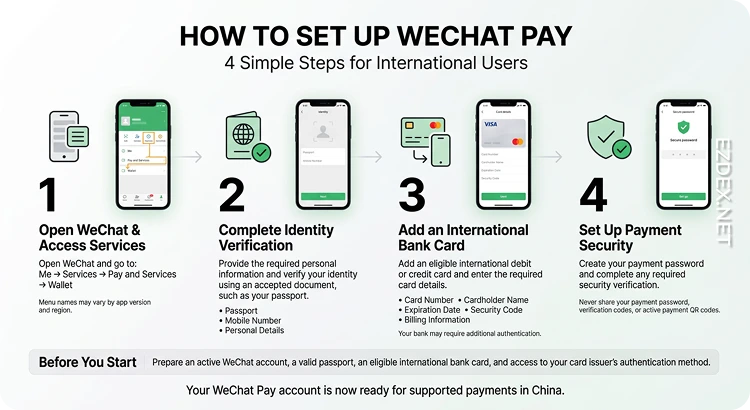
Step 1: Open WeChat and Access Services
Open the WeChat app and go to the payment-related section, usually found under areas such as:
• Me
• Services
• Pay and Services
• Wallet
Step 2: Complete Identity Verification
WeChat Pay may require identity verification before activating certain payment features.
International users may be asked to provide passport details and other personal information.
Step 3: Add an International Bank Card
Choose the option to add a bank card and enter the requested information.
This may include:
- card number
- cardholder name
- expiration date
- security code
- billing information
- registered mobile number
Your bank may require additional authentication before the card is successfully linked.
Step 4: Complete the Payment Security Setup
You may be asked to create a payment password or complete another security step before using WeChat Pay.
Never share payment passwords, verification codes, or active payment QR codes with another person.
Can International Buyers Pay Chinese Suppliers With WeChat Pay?
Yes, in some situations.
Chinese suppliers may accept WeChat Pay for smaller or faster transactions, particularly when dealing with samples, service fees, sourcing costs, logistics, deposits, or smaller product orders.
However, buyers should first determine what type of WeChat Pay payment the supplier is requesting.
The seller may provide:
• a merchant QR code
• a personal payment QR code
• a payment request
• a WeChat account linked to a merchant
• an alternative RMB payment method
These options are not equivalent from a business-risk perspective.
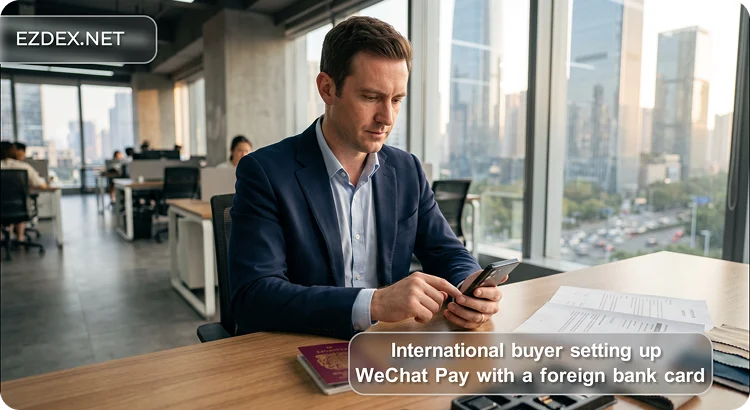
Merchant Payment vs Personal WeChat Transfer
A merchant payment is generally tied to a business payment environment and may provide clearer transaction details.
A personal WeChat transfer may simply send money to an individual's account.
For commercial purchases, especially when dealing with a new supplier, verify why the payment is going to a personal account before sending funds.
Ask the seller to confirm:
• the recipient's full name
• whether the account belongs to the company or an authorized representative
• the order or invoice number
• the exact RMB amount
• what goods or services the payment covers
For higher-value B2B payments, a formal bank transfer or dedicated RMB payment service may provide better documentation and transaction traceability.
How to Pay a Chinese Supplier With WeChat Pay
If you buy products or services from China, a supplier may ask you to pay through WeChat Pay. This is especially common for smaller orders, samples, sourcing fees, inspection services, logistics charges, or other relatively fast payments.
Before sending money, first confirm exactly how the supplier wants to receive the payment.
A supplier may send you:
• a merchant QR code
• a personal WeChat payment code
• a payment request
• a Mini Program checkout link
• another RMB payment option
For business purchases, a merchant payment is generally preferable to sending money to an unrelated personal account because it can provide clearer transaction context.
WeChat Pay for Goods and Services Purchased From China
WeChat Pay may be used for different types of China-related purchases, including:
• product samples
• sourcing agent fees
• factory deposits
• inspection services
• packaging or design services
• local logistics charges
• small wholesale orders
• manufacturing-related services
However, WeChat Pay should not automatically be treated as the best option for every B2B transaction.
The larger the payment, the more important documentation, recipient verification, and payment traceability become.
What If You Cannot Pay the Supplier Directly?
An international buyer may be unable to complete a requested WeChat payment because of card restrictions, transaction limits, account eligibility, or the type of QR code provided by the supplier.
In that situation, ask the seller whether they can accept another verified payment method.
For buyers who need to send RMB to a Chinese supplier, a dedicated RMB payment or transfer service can be a practical alternative, particularly when the supplier specifically requests settlement in Chinese yuan.
This can also be useful when paying for sourcing, logistics, manufacturing, or other China-based services without relying on a personal WeChat transfer.
Is It Safe to Pay a Chinese Supplier Through WeChat Pay?
WeChat Pay uses identity checks, payment authentication, transaction monitoring, and anti-fraud controls. Tencent also states that Weixin Pay can show warnings when a transaction is considered potentially risky.
For supplier payments, the main risk is often not the payment technology itself but sending money to the wrong person or to an account that is not clearly connected to the company you are buying from.
Before paying, verify:
• the supplier's legal or trading name
• the recipient name shown before payment
• the invoice or order reference
• the exact amount in RMB
• why a personal account is being used, if applicable
Frequently Asked Questions
Can foreigners use WeChat Pay in China?
Yes. International visitors can link eligible foreign bank cards to WeChat Pay and use them for supported merchant payments in mainland China.
Do I need a Chinese bank account to use WeChat Pay?
Not for many merchant transactions. Eligible international cards can be linked directly to WeChat Pay. However, some wallet, transfer, and person-to-person features may have additional requirements.
Can I send a WeChat Pay transfer to China from abroad?
This depends on your account, linked payment method, transaction type, and the way the recipient accepts payment. International cards are primarily designed for supported merchant payments and may not work for every personal transfer or supplier QR code.
If a supplier requires RMB and direct WeChat Pay payment is not available, a dedicated RMB transfer service may be a more practical option.
Can I use Visa or Mastercard with WeChat Pay?
Yes. Weixin Pay supports major international card networks including Visa and Mastercard. Other supported networks include American Express, JCB, Discover Global Network, Diners Club, and UnionPay.
Actual acceptance may still depend on the card issuer and transaction.
How much does WeChat Pay charge for foreign cards?
International-card transactions of RMB 200 or less are currently exempt from the standard international-card processing fee.
First-time users who link an eligible international card can also receive a 3% processing-fee waiver for 90 consecutive days, subject to the applicable daily spending limit.
Your bank may still charge currency-conversion or foreign-transaction fees.
Is WeChat Pay suitable for large supplier payments?
It can be convenient for smaller or time-sensitive payments, but it is not always the best option for large B2B transactions.
For larger orders, formal bank transfers or documented RMB payment services may offer clearer beneficiary information, accounting records, and transaction traceability.
Latest in Payment Systems Tutorials
All articles in this category